

Top
Authors
Published
20 Nov 2026Form Number
LP2584PDF size
11 pages, 435 KBSubscribed to LP2584.
Thank you for your feedback.
Table of Contents
Abstract
Organizations adopting AI need visibility into its use, protection for sensitive data, and ongoing oversight of deployed models. This solution brief presents Cognome’s integrated AI governance and security platform on Lenovo ThinkSystem servers powered by Intel® Xeon® 6 processors, with a focus on healthcare and governance needs shared across regulated industries. It explains how AI Sniffer™ discovers sanctioned and shadow AI, ExplainerAI™ connects model intake with continuous monitoring and clinician-level explainability, and SOLUS™ brings findings together into healthcare AI risk intelligence.
The brief covers customer use cases, business outcomes, solution architecture, and infrastructure sizing, with on-premises and customer private-cloud deployment options that support data sovereignty and responsible AI adoption.
Executive Summary
Healthcare organizations expanding AI across clinical, operational, and administrative workflows need to discover AI in use, govern approved models, and understand how those models produce their outputs. A model registry establishes an inventory, monitoring reveals behavior over time, and explainability provides transparency and traceability. Effective oversight requires these capabilities to work together.
Cognome connects AI Sniffer™ for agentless AI discovery and security, ExplainerAI™ for model intake, continuous monitoring, and clinician-level explainability, and SOLUS™ for correlated healthcare AI risk intelligence. Together, they help health systems identify sanctioned and shadow AI, protect sensitive information, monitor Responsible AI Use including drift, bias, and hallucinations, and maintain evidence for governance reviews and audits.
Deployed on Lenovo ThinkSystem infrastructure powered by Intel® Xeon® 6 processors, the solution runs on premises or in the customer’s private cloud with no Cognome SaaS component. CPU-based inference supports ExplainerAI workloads, with GPU configurations available when warranted. Lenovo compute, memory, storage, and support services provide a scalable foundation for AI oversight while keeping governance data within the customer’s environment.
Business Challenge
AI adoption is outpacing traditional healthcare governance practices. Clinical leaders, cybersecurity teams, and IT administrators need to know which AI tools are active, how production models behave, and whether their outputs can be understood and reviewed.
- Unseen AI usage: Local models, embedded vendor AI, and unauthorized tools can operate outside central inventories. Biomedical and medical IoT devices may not support endpoint agents, creating additional discovery gaps.
- Incomplete model oversight: A model registry records what has been approved but does not provide continuous monitoring or explainability. Health systems need a connected process for model intake, performance oversight, and transparent review of outputs.
- Sensitive data exposure: Everyday actions, such as pasting patient information into a public chatbot, can expose protected health information and create privacy risks.
- Evolving model behavior: Performance degradation, drift, bias, and hallucinations can emerge after deployment, requiring ongoing monitoring and investigation.
- Fragmented evidence and ownership: Records spread across teams make governance reviews difficult, while abandoned AI without a clear owner can remain active and unmanaged.
- Gaps in existing security coverage: Endpoint, network, and Microsoft security tools serve important roles, but may not identify AI-specific activity or provide clinical model governance.
Health systems need coordinated AI discovery, monitoring, and explainability that works alongside existing security tools and keeps sensitive governance data within their environment.
Solution Overview
Lenovo and Cognome combine enterprise infrastructure with an integrated healthcare AI governance and security platform. AI Sniffer™ discovers AI across the network without requiring endpoint software. Discovered models can move into ExplainerAI™ through a guided onboarding wizard, pre-filled from their discovery records, connecting discovery with model intake and continuous monitoring. SOLUS™ correlates discovery and governance findings into healthcare AI risk intelligence. The platform runs on premises or in the customer’s private cloud with no Cognome SaaS component.
AI Discovery, Security and Model Governance
Cognome connects AI discovery, model intake, monitoring, and explainability in one governance workflow. Health systems can identify previously unknown AI, onboard models for oversight, and correlate findings across clinical, security, and compliance teams.
Discover AI across the environment
AI Sniffer discovers AI across networks without requiring software installation on the devices being inspected. Network scans, file inspection, and discovery sources such as DNS logs help identify local models, vendor-embedded AI, and shadow AI, including biomedical and medical IoT devices that cannot carry an agent. Cognome works alongside existing endpoint, network, and Microsoft security tools to provide AI-specific visibility.
Optional AI Sniffer Agents add deeper endpoint visibility and PHI protection. Agents classify clipboard content as users interact with AI tools, helping identify patient information being pasted into public chatbots. Cognome detects 16 of the 18 HIPAA identifiers, with sensitive-content classification performed locally. Endpoint controls support quarantine or blocking of endpoints running unauthorized AI.
Connect discovery to model governance
Models discovered by AI Sniffer can be onboarded into ExplainerAI through a guided wizard pre-filled from their discovery records. This connects discovery with model registry and intake, helping teams establish ownership and configure ongoing monitoring.
ExplainerAI monitors onboarded models for Responsible AI Use, including drift, bias, hallucinations, and performance changes. Model-specific thresholds and centralized alerts support investigation, while clinician-level explainability provides transparency and traceability for reviewing model outputs.
Correlate healthcare AI risk
SOLUS brings together discovery findings and model governance evidence to support coordinated risk review. It maps findings to HIPAA, NIST AI RMF, HSCC AI Governance, and NIH Responsible AI, helping teams maintain evidence for governance reviews and audit preparation.
Discovery also helps identify abandoned AI that lacks an accountable owner, supporting investigation and retirement of unmanaged assets.
Integration with Healthcare Systems
ExplainerAI integrates with Epic and other EHR environments, with Cognome’s AutoETL connector supporting deeper Epic monitoring and analytics. Customer planning establishes the required interfaces, data access, HL7 message volumes, and monitoring feeds.
Coverage of AI agents and MCP servers is in development.
Target Healthcare Use Cases
Healthcare organizations can apply Cognome’s integrated platform to discover AI, protect patient information, and govern models throughout their operational lifecycle.
The following table lists some use cases:
Business Outcome
In the following sections, we take a deeper dive:
Business Outcome
Lenovo and Cognome help healthcare organizations expand AI adoption with clearer accountability, stronger patient-data protection, and more predictable operating costs.
- More complete AI visibility: Discover sanctioned, shadow, and abandoned AI across the enterprise, including devices that cannot carry endpoint agents.
- Connected governance throughout the AI lifecycle: Move discovered models through intake, registration, and ongoing monitoring, helping teams establish ownership and maintain oversight.
- Stronger clinical AI accountability: Combine Responsible AI Use monitoring with clinician-level explainability to support transparent, traceable review of model behavior and outputs.
- Reduced exposure and incident impact: Identify endpoint PHI risks and unmanaged AI, helping teams investigate incidents and retire abandoned assets that create ongoing exposure.
- More efficient governance reviews: Correlate inventory, alerts, and supporting evidence to streamline investigations, risk assessments, and audit preparation.
- Data sovereignty: Run on premises or in the customer’s private cloud with no Cognome SaaS component, keeping governance data within the customer’s environment.
- More predictable costs: Cognome’s pricing has no consumption fees, while CPU-based ExplainerAI configurations provide an infrastructure option without dedicated GPUs for suitable workloads.
Recommended Infrastructure Sizing
AI Sniffer™ and ExplainerAI™ running on Lenovo infrastructure help healthcare organizations discover AI activity, govern deployed models, and turn findings into actionable risk information across network, endpoint, and edge environments.
Lenovo ThinkSystem SR630 V4 and SR650 V4 servers provide a scalable foundation for these workloads. The following table presents infrastructure configurations based on Cognome’s AI Sniffer Server and ExplainerAI compute requirements.
Proposed Lenovo Platform Mapping
ThinkSystem SR630 V4 and SR650 V4 are proposed as the server platform family for Cognome’s containerized workloads. Final platform selection, physical host count, CPU/RAM population, GPU compatibility, network design, and high-availability layout require a Lenovo–Cognome design review.
Note: Configurations use Lenovo ThinkSystem SR630 V4 or SR650 V4 servers. Memory follows the recommended balanced DIMM population of eight DIMMs per CPU, providing capacity above Cognome’s stated requirements as headroom. CPU core counts and total memory represent the combined capacity across all physical servers listed.
Endpoint count determines AI Sniffer sizing, while governed model count determines ExplainerAI sizing. Each capability should be sized according to customer requirements. Extra-large deployments require custom sizing. Final configurations depend on workload, deployment, and availability requirements.
Solution Architecture
The solution connects agentless AI discovery, optional endpoint protection, and production-model governance on Lenovo ThinkSystem infrastructure. AI Sniffer™ discovery records support guided onboarding into ExplainerAI™, linking model intake and registration with continuous monitoring and clinician-level explainability. SOLUS™ correlates discovery findings and governance evidence into unified healthcare AI risk intelligence.
The diagram below provides a conceptual view of the design and solution flow.
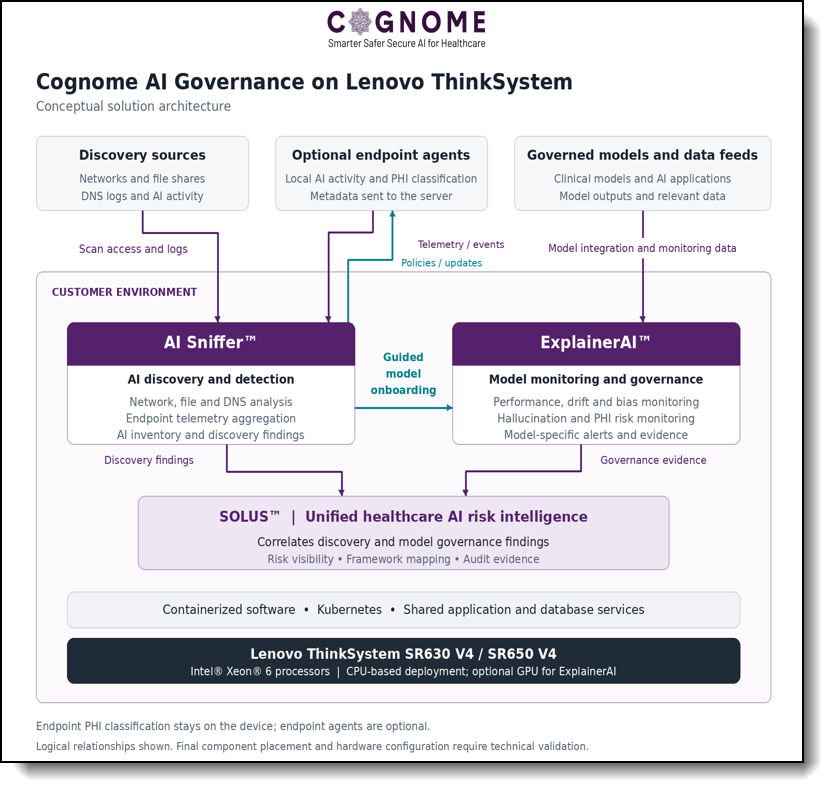
Figure 1. Conceptual Cognome AI discovery and governance on Lenovo ThinkSystem
Infrastructure and Integration Considerations
Cognome’s server-side services run as containers orchestrated by Kubernetes within the customer’s environment. Combined deployments share application and database services, while AI Sniffer ingest capacity and ExplainerAI inference resources are sized independently. Optional endpoint agents classify sensitive content locally, send metadata and events to the discovery server, and receive policies and updates through secure, bidirectional communication.
The platform runs on premises or in the customer’s private cloud with no Cognome SaaS component, keeping governance data within the customer’s environment. Healthcare integrations provide the model and clinical data needed for monitoring, while SOLUS maps findings to HIPAA, NIST AI RMF, HSCC AI Governance, and NIH Responsible AI.
Table below lists the Infrastructure and integration considerations
Cognome notes: Configurations below three Kubernetes control-plane nodes do not provide control-plane high availability, and a node failure may require manual recovery. Requirements for enhanced availability and security hardening should be established before a production design is approved.
Getting Started
Organizations can begin with Cognome’s Shadow AI Discovery or Shadow AI Risk Assessment engagement to establish AI visibility and identify governance priorities. An initial AI inventory can be available in days, depending on scope. Lenovo and Cognome then work with the customer to define model onboarding, healthcare integrations, security requirements, and infrastructure sizing for ongoing governance.
Related Links
For more information, see these resources:
- For more information about Lenovo solutions, contact your Lenovo representative or Business Partner, or visit Lenovo servers.
- For more information about Cognome’s AI discovery, security, and governance capabilities, visit Cognome
Product features, validation status, and availability should be checked with Lenovo and Cognome before customer publication.
Authors
Erik Robert is an AI Ecosystem and Solutions professional focused on identifying, developing, and bringing enterprise AI solutions to market through collaboration with independent software vendors (ISVs), infrastructure teams, and strategic technology partners. His work centers on evaluating emerging AI technologies and aligning them with scalable reference architectures across compute, storage, and software platforms. With experience spanning solution strategy, platform positioning, and AI go-to-market initiatives, Erik’s goal is to help organizations adopt practical, production-ready AI solutions that deliver measurable business value.
Abed Islam is a Solutions Architect focused on designing scalable, practical AI platforms for enterprise and edge environments. His work centers on integrating compute, storage, networking, and AI software stacks through close collaboration with technology partners and industry providers. With technical experience in infrastructure architecture and deployment, Abed’s goal is to make advanced AI capabilities accessible, reliable, and production-ready for real-world use.
Trademarks
Lenovo and the Lenovo logo are trademarks or registered trademarks of Lenovo in the United States, other countries, or both. A current list of Lenovo trademarks is available on the Web at https://www.lenovo.com/us/en/legal/copytrade/.
The following terms are trademarks of Lenovo in the United States, other countries, or both:
Lenovo®
ThinkSystem®
The following terms are trademarks of other companies:
Intel®, the Intel logo and Xeon® are trademarks of Intel Corporation or its subsidiaries.
Linux® is the trademark of Linus Torvalds in the U.S. and other countries.
Microsoft® is a trademark of Microsoft Corporation in the United States, other countries, or both.
Other company, product, or service names may be trademarks or service marks of others.
Configure and Buy
Please select a locale
Full Change History
Course Detail
Employees Only Content
The content in this document with a is only visible to employees who are logged in. Logon using your Lenovo ITcode and password via Lenovo single-signon (SSO).
The author of the document has determined that this content is classified as Lenovo Internal and should not be normally be made available to people who are not employees or contractors. This includes partners, customers, and competitors. The reasons may vary and you should reach out to the authors of the document for clarification, if needed. Be cautious about sharing this content with others as it may contain sensitive information.
Any visitor to the Lenovo Press web site who is not logged on will not be able to see this employee-only content. This content is excluded from search engine indexes and will not appear in any search results.
For all users, including logged-in employees, this employee-only content does not appear in the PDF version of this document.
This functionality is cookie based. The web site will normally remember your login state between browser sessions, however, if you clear cookies at the end of a session or work in an Incognito/Private browser window, then you will need to log in each time.
If you have any questions about this feature of the Lenovo Press web, please email David Watts at dwatts@lenovo.com.


