

Top
Author
Published
17 Nov 2026Form Number
LP2568PDF size
13 pages, 496 KBSubscribed to LP2568.
Thank you for your feedback.
Abstract
Organizations are re-evaluating their virtualization and private cloud strategies because of rising licensing costs, vendor lock-in, and the need for digital sovereignty. Canonical OpenStack on Lenovo ThinkSystem SR630 V4 and SR650 V4 servers delivers an open-source, enterprise-grade private cloud that combines pure upstream OpenStack (KVM compute, OVN networking, and Ceph storage), full-stack automation, and up to 15 years of security maintenance with Ubuntu Pro and its Legacy add-on. The architecture scales from a three-node hyperconverged cloud to multi-rack deployments of hundreds of nodes, all on Lenovo ThinkSystem SR630 V4 and SR650 V4 infrastructure.
Lenovo offers small, medium and large reference configurations, each built around Lenovo Top Choice Express core components so customers can order a reference cloud configuration with faster delivery than a standard configure-to-order build.
Introduction
Private cloud has become a strategic layer of enterprise IT. It hosts traditional virtual machines, cloud-native applications and, increasingly, AI workloads. IT teams need the agility of public cloud together with control over data location, security posture, and cost.
OpenStack is the de facto open-source standard for building private and sovereign clouds, and banks, governments, telcos, and enterprises have run it in production for more than a decade. Canonical has contributed to OpenStack since the project began and is one of its largest contributors. It also publishes Ubuntu, the most widely used operating system for OpenStack deployments.
Canonical OpenStack is an upstream-aligned distribution with no forks and no proprietary extensions. Model-driven automation turns OpenStack from a complex integration project into a repeatable, supportable product. Running it on Lenovo ThinkSystem SR630 V4 and SR650 V4 servers gives customers a reference architecture for a production cloud, with lower deployment risk and faster time to value.
Business Challenge
Infrastructure teams face pressure on several fronts at once:
- Escalating licensing costs: per-core, subscription-only hypervisor licensing and forced product bundling increase total cost of ownership (TCO) and make budgets unpredictable.
- Vendor lock-in: proprietary virtualization stacks restrict architectural choice and make it costly to leave.
- Digital sovereignty and compliance: regulations and data-residency rules demand full control over where data lives, who operates the platform, and how it is secured.
- Operational complexity: integrating and running compute, network, storage, and observability as a cloud requires deep expertise that many teams lack.
- Long-term security and lifecycle: infrastructure must stay patched and compliant for many years, and upgrades must not disrupt workloads.
- Modern and AI workloads: a single platform must serve VMs, Kubernetes, and GPU-accelerated workloads side by side.
Solution
Canonical OpenStack on Lenovo ThinkSystem SR630 V4 and SR650 V4 is an open, software-defined private cloud built from a small number of well-integrated layers:
- Lenovo ThinkSystem SR630 V4 and SR650 V4 servers: the primary hardware platforms for the solution. The 1U SR630 V4 supports dense, scale-out cloud nodes, while the 2U SR650 V4 provides greater expansion flexibility for storage-rich, accelerator-enabled, and mixed-role configurations. Both platforms use Intel Xeon 6 processors, DDR5 memory, PCIe Gen5, NVMe storage options, and Lenovo XClarity Controller management. Both platforms are Ubuntu certified for Ubuntu 22.04, 24.04 and 26.04 LTS.
- Ubuntu Server LTS with Ubuntu Pro: the host OS on every node, with Livepatch rebootless kernel patching and long-term security maintenance.
- Canonical MAAS and Juju: MAAS (Medium and Large) discovers, tests, and deploys bare-metal servers, while Juju charms deploy, integrate, scale, and upgrade every cloud service consistently.
- Canonical OpenStack: Nova on KVM, Neutron with OVN, Cinder, Glance, Keystone, and Horizon, plus optional object storage, load balancing, DNS, file shares, telemetry, and instance high availability.
- Canonical Ceph, COS, and Landscape: scale-out block, object, and file storage; integrated metrics, logs, and alerting; and fleet-wide patching and compliance.
The following figure shows how these layers fit together. Lenovo ThinkSystem SR630 V4 and SR650 V4 servers, the XClarity Controller, and a redundant Ethernet fabric form the physical foundation. Ubuntu Server with Ubuntu Pro runs on every node. MAAS and Juju deploy and operate the OpenStack services above it, while COS and Landscape provide observability, patching and compliance. The Small design leaves out MAAS, COS and Landscape, as described in the Reference Configurations section. Users and DevOps teams consume compute, networking, storage, and security services through standard OpenStack APIs and tools, so virtual machines, Kubernetes clusters, and GPU workloads all run on one shared, open platform.
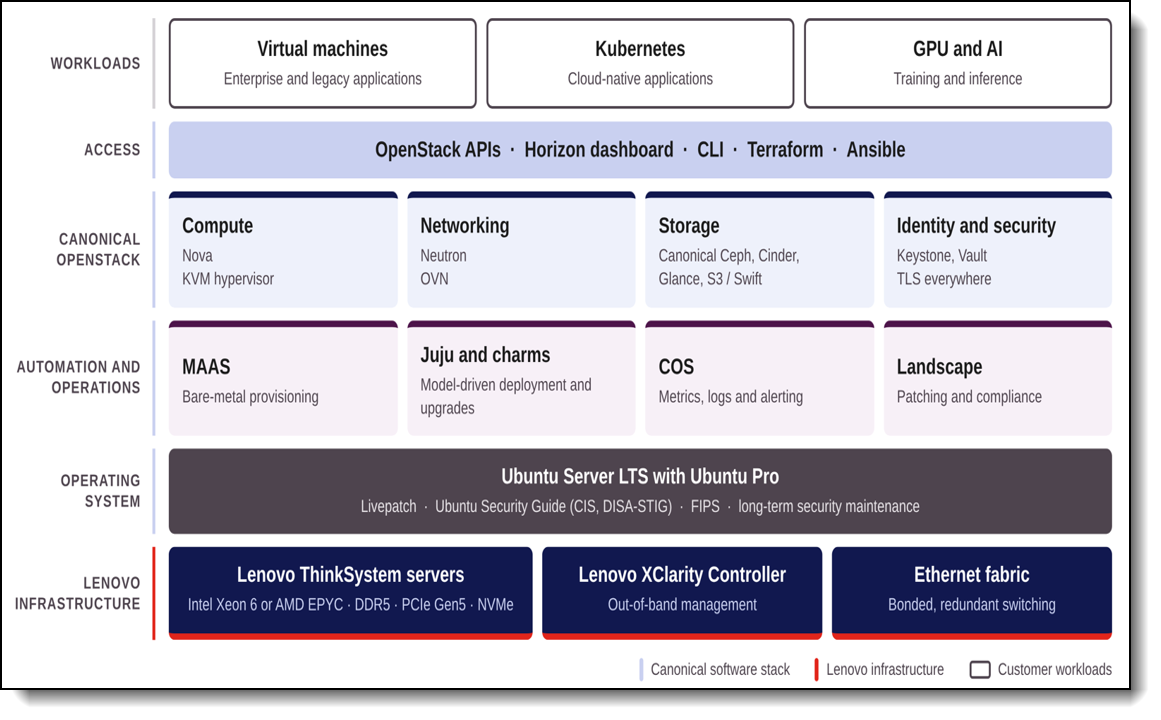
Figure 1. Canonical OpenStack on Lenovo ThinkSystem SR630 V4 and SR650 V4 solution architecture.
Resilient and secure by design
Every control-plane service runs as a three-member cluster spread across availability zones, Ceph keeps three copies of the data, and server networking is bonded to redundant switches, so the design has no single point of failure. Security features include TLS on all endpoints, Vault Secrets management, encryption at rest, DISA-STIG and CIS hardening through the Ubuntu Security Guide, and FIPS certified cryptographic modules for the Ubuntu host. Updates are applied in a rolling fashion to minimize workload disruption, and LTS releases follow a supported upgrade path.
Simplified deployment and management
MAAS and Lenovo XClarity work side by side. MAAS automates the server lifecycle and uses the XClarity Controller for power control over IPMI, while XClarity manages firmware compliance, hardware health and alerts, and remote console. Canonical engineers can design and deploy the cloud on the customer's Lenovo ThinkSystem SR630 V4 or SR650 V4 hardware; customers then operate it themselves with Ubuntu Pro + Support or choose a fully managed service from Canonical, backed by Lenovo services and Premier Support for the hardware.
XCC3 ships with IPMI over LAN turned off, so every medium and large node is ordered with the factory option to enable it (feature B7Y0). MAAS also needs a dedicated XCC3 account with administrator rights and a password that does not expire, and its rack controllers must be able to reach the XCC3 management network. The Small design does not use MAAS and needs none of this.
Faster delivery with Lenovo Top Choice Express
Lenovo Top Choice Express is a configure-to-order program built on a curated set of the most popular components. Customers still choose the configuration they need, but the servers are built and fully integrated in Lenovo manufacturing with simpler configuration, instant pricing and significantly shorter lead times than a standard configure-to-order build.
The reference configurations in this brief are designed around Top Choice Express. The SR630 V4 and SR650 V4 chassis, processors, memory, NVMe backplanes, UEFI presets and the IPMI-over-LAN setting all come from the Top Choice Express component list, which helps customers move from purchase order to a running cloud sooner. Top Choice Express status for the drives, boot kits, network adapters and power supplies will be confirmed as their part numbers are finalized.
Uses Cases
Migrating off proprietary virtualization
Organizations facing steep hypervisor renewals can consolidate virtualized workloads onto KVM-based Canonical OpenStack running on ThinkSystem SR630 V4 and SR650 V4 servers. A simple per-node subscription replaces per-core and per-VM licensing, so costs become predictable as the environment grows. Standard OpenStack APIs, Terraform, and Ansible give operations teams a familiar automation path, and the open stack removes the exit costs that made the previous platform hard to leave.
Sovereign cloud for the public sector and regulated industries
Government agencies, financial institutions, and service providers need self-service infrastructure-as-a-service while keeping full control of data location and operations. Canonical OpenStack delivers multi-tenant IaaS with quotas and metering on hardware the organization owns, in facilities it chooses, running transparent open-source code. FIPS certified cryptographic modules for the Ubuntu host, DISA-STIG and CIS hardening, and up to 15 years of security maintenance available with Ubuntu Pro support long-lived compliance programs.
AI and machine learning close to the data
Data science teams want GPU capacity without moving sensitive data to a public cloud. The same OpenStack cloud provides GPU-accelerated instances through PCI passthrough, alongside Kubernetes clusters for training and inference, so AI workloads run next to the data and share the platform's automation, observability, and security controls with conventional VMs.
Workloads
Cloud functions (control, compute, and storage) are assigned to servers as roles and combined into one of three reference designs. Services, APIs, and the operating model are identical across all three:
- Entry (hyperconverged): minimum 3 nodes; survives a node failure. Suited to edge sites, remote offices, and starter clouds.
- Production (converged): minimum 12 nodes (3 infrastructure plus 9 cloud); survives the loss of a full availability zone or rack. Suited to general-purpose enterprise clouds.
- Scale-out (disaggregated): 3 infrastructure nodes plus dedicated control, compute, and storage nodes; survives the loss of an availability zone. Suited to large clouds and service providers.
Supported workload profiles include general-purpose VMs, Kubernetes on OpenStack, GPU-accelerated instances, and telco network functions using SR-IOV, CPU pinning and huge pages on dedicated compute nodes, with DPDK subject to design validation.
Lenovo has sized a ready-to-quote starting point for each design, called Small, Medium and Large. They are described in the next section.
Reference Configurations
Each reference design maps to a Lenovo configuration built from ThinkSystem SR630 V4 and SR650 V4 servers. All three follow Canonical's sizing guidelines, and all three run the same software, so customers can start small and grow without learning a new platform. The core of every server (chassis, processors, memory, NVMe backplanes and BIOS preset) uses Lenovo Top Choice Express components, which shortens delivery compared with a standard configure-to-order build. Table 1 compares them.
The VM figures already hold back enough capacity to ride through the failure listed, and assume a 2:1 CPU overcommit with no memory overcommit. Usable storage allows for Ceph keeping three copies of every object, one per availability zone, and keeps 25% of the cluster free so Ceph can rebuild data after a drive failure.
Configuration choices common to every size
- Boot: two 960GB M.2 NVMe drives mirrored in RAID-1, kept separate from the data drives.
- Storage: enterprise read-intensive NVMe drives with power-loss protection, connected straight to the processors through the onboard NVMe ports. No RAID controller or HBA sits in the path. Each drive runs as one Ceph OSD, and every node in a storage tier uses the same number and size of drives. Unbalanced nodes or racks reduce usable capacity, because each availability zone holds one full copy of the data and the smallest one sets the limit.
- Memory: every memory channel on both processors is populated equally, so memory stays balanced. Nodes with one DIMM per channel run at 6400 MHz. Nodes that reach 2 TB use two 64GB DIMMs per channel, which runs at 5200 MHz and keeps the build on Top Choice Express parts.
- Top Choice Express: chassis, processors, memory, NVMe backplanes and UEFI presets come from the Top Choice Express component list for each platform. The remaining components will be confirmed as part numbers are finalized.
- Network: one OCP 3.0 adapter and one PCIe adapter in every node, bonded with LACP to a redundant switch pair, so the loss of an adapter or a switch does not take a node offline. Use passive copper (DAC) cables or optical transceivers at 100GbE in SR630 V4 nodes, because active optical cables tighten that server's thermal limits.
- Management: a dedicated 1GbE XClarity Controller 3 port on a separate management switch, and the optional XCC3 Premier upgrade for remote console and virtual media. In the Medium and Large designs, the MAAS rack controllers on the infrastructure nodes must reach this network; avoid multi-path routing on it, because it disrupts IPMI.
Small: Entry hyperconverged
Three 1U servers each run control, compute and storage. The Small design is installed manually: Ubuntu Server is installed on each server, and Canonical OpenStack is then deployed with its snap-based installer. It does not include MAAS, a separate observability stack or Landscape, and all cloud traffic shares a single network. These trade-offs keep the footprint to three servers and make Small the entry-level design; the Medium and Large designs add dedicated infrastructure nodes and separate networks. Two 32-core processors per node give Ceph enough CPU without crowding out tenant VMs, and the 10-bay NVMe backplane ships with six drives so capacity can grow in place. With three nodes and three data copies, a failed node leaves Ceph running on two copies until it is replaced, which suits edge and starter clouds well.
Medium: Production converged
Three small infrastructure nodes run MAAS, Juju, COS and Landscape. Nine 2U cloud nodes share control, compute and storage, three per rack, with each rack acting as its own availability zone. Each cloud node pairs two 64-core processors with 2 TB of memory, which leaves about 384 vCPUs and 1.9 TB of RAM per node for tenant VMs after Ceph and the control plane take their share. The SR650 V4 leaves eight drive bays and spare PCIe slots free in every cloud node, so customers can add storage or accelerators later. 100GbE networking keeps Ceph rebuilds fast on drive-dense nodes.
Each of the three racks gets a 100GbE leaf switch pair and a 1GbE management switch, and two spine switches running BGP with ECMP tie the racks together. The control plane services sit behind virtual IPs spread across the racks, so the API, internal and provider networks must span all three racks. The fabric has to provide those networks, and Canonical defines the exact network layout during design.
Large: Scale-out disaggregated
Every role has its own servers, so compute and storage grow independently. Compute nodes pack two 64-core processors and 2 TB of memory into 1U. Storage nodes use all 24 front NVMe bays of the SR650 V4, with separate 100GbE networks for client access and replication. The design scales to roughly 200 to 250 nodes in a single cloud; beyond that, customers add regions.
Large adds 11,904 vCPUs and about 48 TB of RAM across the compute tier, with about 2.2 PB of raw NVMe in the storage tier. Customers who want AI close to their data can add one SR650 V4 GPU node per availability zone, each with two 32-core Xeon 6730P processors, two double-wide data-center GPUs and 1 TB of memory, placed in its own host aggregate. Specific GPU models will be listed in a future revision.
Growing the cloud
Small grows by filling its empty drive bays and then by adding nodes in sets of three. Medium grows by adding cloud nodes three at a time, one per rack, and filling the free bays in each cloud node. Moving from Medium to Large means adding dedicated compute and storage nodes and moving control services onto their own servers, which is done as a planned migration with Canonical's automation rather than a new deployment. Moving from Small to Medium is a new deployment with workload migration, because Medium adds automated bare-metal provisioning, dedicated infrastructure nodes, separate networks and rack-level availability zones; the SR630 V4 servers can be reused in the new cloud.
Business Outcome
Canonical OpenStack on Lenovo ThinkSystem SR630 V4 and SR650 V4 delivers value in several measurable areas:
- Lower, predictable TCO: no per-VM or per-core licensing; one per-node subscription covers the software stack, with Ceph capacity beyond the amount included in Ubuntu Pro priced per terabyte.
-
Freedom of choice: upstream OpenStack APIs, standard KVM, OVN, and Ceph, and industry-standard Lenovo ThinkSystem SR630 V4 and SR650 V4 hardware remove lock-in.
-
Operational simplicity: model-driven automation handles deployment, scaling, upgrades, and observability, reducing the specialist effort a cloud demands.
-
Faster time to value: reference configurations built around Lenovo Top Choice Express core components ship with shorter lead times than standard configure-to-order builds.
-
Enterprise resilience: a highly available design tolerates the loss of a node, a rack, or an availability zone.
-
Long-term security: up to 15 years of security maintenance per Ubuntu LTS release (10 years with Ubuntu Pro and 5 more with the Legacy add-on), plus compliance tooling.
Specific TCO and performance figures for this solution have not yet been published. Contact your Lenovo representative for a sizing and cost comparison based on your environment.
Bill of Materials
The following table lists the bill of materials for the Medium configuration, the design most enterprise clouds start from. Quantities are totals for the whole cloud. Processors, memory, chassis, backplanes, the UEFI preset and the IPMI-over-LAN option are all Top Choice Express components, and DCSC selects the heatsinks automatically; the TCE column marks the items whose Top Choice Express status will be confirmed when their part numbers are finalized in a future revision. Contact your Lenovo representative for the Small and Large bills of materials.
Top Choice Express ship dates are estimates, and availability of individual components can vary by region. Check the Top Choice Express column in the Lenovo Data Center Solution Configurator (DCSC) for your region when building the quote. Ceph capacity beyond the amount included in Ubuntu Pro is priced per terabyte by Canonical.
Conclusion
Canonical OpenStack on Lenovo ThinkSystem SR630 V4 and SR650 V4 delivers an open, secure, and cost-predictable private cloud that combines upstream OpenStack, model-driven automation, and long-term security maintenance with Lenovo's enterprise-class infrastructure. The architecture scales from edge to data center, and customers can operate it themselves with Canonical support or have Canonical manage it for them. For organizations moving away from costly proprietary virtualization, or building sovereign and AI-ready clouds, it offers a practical, low-risk path to cloud agility on their own terms.
With Small, Medium and Large reference configurations built on Lenovo Top Choice Express, customers can size, quote and receive their cloud hardware faster.
For More Information
To learn more about Canonical OpenStack on Lenovo ThinkSystem SR630 V4 and SR650 V4, contact your Lenovo representative or Lenovo Business Partner, or visit the resources below. References:
- Canonical OpenStack:
https://ubuntu.com/openstack - Canonical OpenStack documentation:
https://canonical.com/openstack/docs/stable-2024.1/ - Ubuntu Pro:
https://ubuntu.com/pro - Canonical Charmed Kubernetes on Lenovo ThinkSystem for AI Development:
https://lenovopress.lenovo.com/lp1415-canonical-charmed-kubernetes-on-thinksystem-for-ai-development - Lenovo OS Interoperability Guide:
https://lenovopress.lenovo.com/osig - MAAS (Metal as a Service):
https://canonical.com/maas
Authors
Jessie Lacome is a Platform Solutions Product Manager at Lenovo with extensive experience in enterprise virtualization and modern infrastructure platforms. He brings a strong consulting and solutions architecture background, supporting customers across on‑premises and hybrid environments. Jessie has previously held roles at Salesforce, Citrix, and Dell, where he focused on virtualization and infrastructure solutions.
Trademarks
Lenovo and the Lenovo logo are trademarks or registered trademarks of Lenovo in the United States, other countries, or both. A current list of Lenovo trademarks is available on the Web at https://www.lenovo.com/us/en/legal/copytrade/.
The following terms are trademarks of Lenovo in the United States, other countries, or both:
Lenovo®
ThinkSystem®
XClarity®
The following terms are trademarks of other companies:
Intel®, the Intel logo and Xeon® are trademarks of Intel Corporation or its subsidiaries.
Terraform® is a trademark of IBM in the United States, other countries, or both.
Other company, product, or service names may be trademarks or service marks of others.
Configure and Buy
Please select a locale
Full Change History
Course Detail
Employees Only Content
The content in this document with a is only visible to employees who are logged in. Logon using your Lenovo ITcode and password via Lenovo single-signon (SSO).
The author of the document has determined that this content is classified as Lenovo Internal and should not be normally be made available to people who are not employees or contractors. This includes partners, customers, and competitors. The reasons may vary and you should reach out to the authors of the document for clarification, if needed. Be cautious about sharing this content with others as it may contain sensitive information.
Any visitor to the Lenovo Press web site who is not logged on will not be able to see this employee-only content. This content is excluded from search engine indexes and will not appear in any search results.
For all users, including logged-in employees, this employee-only content does not appear in the PDF version of this document.
This functionality is cookie based. The web site will normally remember your login state between browser sessions, however, if you clear cookies at the end of a session or work in an Incognito/Private browser window, then you will need to log in each time.
If you have any questions about this feature of the Lenovo Press web, please email David Watts at dwatts@lenovo.com.


