

Top
Published
28 Aug 2026Form Number
LP2518PDF size
9 pages, 609 KBSubscribed to LP2518.
Thank you for your feedback.
Abstract
VMware Cloud Foundation 9.1 Memory Tiering, validated on Lenovo ThinkAgile VX V4 with Intel Xeon 6 processors, removes that tradeoff by pairing high speed DRAM with low cost, high capacity NVMe SSDs such as Micron 7600 SSDs to transparently double usable memory. Organizations can run twice the virtual machines per node on the same hardware, reduce total cost of acquisition by up to 45 percent, and retain more than 90 percent of performance across enterprise workloads.
Introduction
Enterprise workloads, from virtual desktops and databases, keep demanding more memory, yet DRAM remains one of the most expensive resources in the data center. As core counts climb with each processor generation, memory capacity and cost, not compute, increasingly cap how many virtual machines a host can support. Market pricing makes the tradeoff acute: server DRAM prices rose more than 90 percent quarter over quarter in early 2026, constrained DDR5 supply pushed per-node prices up roughly 1.7 times, and lead times for memory-dense servers stretched to between 4 and 16 weeks.
VMware Cloud Foundation 9.1 (VCF 9.1) addresses this directly with a production ready Memory Tiering capability. By combining DRAM with NVMe flash under a software defined memory scheduler, VCF 9.1 expands addressable memory without new DIMMs. Validated on Lenovo ThinkAgile VX V4 nodes powered by Intel Xeon 6 processors, the solution turns dense, all NVMe hyperconverged hardware into a platform that doubles virtual machine density while holding performance close to an all DRAM baseline.


Figure 1. VMware Cloud Foundation 9.1 is validated on the ThinkAgile VX650 V4 (top) and VX630 V4 (bottom)
Business Challenge
The problem is not simply that applications need more memory; it is that the memory they need has become dramatically more expensive. DRAM is costly, and infrastructure teams are under constant pressure to do more with the same budget. Traditional memory overcommitment techniques introduce problems of their own:
- Unpredictable performance: ballooning, compression, and swapping reclaim memory at the cost of latency spikes that are difficult to plan around.
- Ongoing administrative effort: overcommitment requires continual tuning and monitoring to avoid degrading production workloads.
- Overprovisioned capacity: to stay safe, teams size DRAM to each virtual machine's peak, leaving memory underused during off peak periods while paying for capacity that is rarely needed.
- Balancing Memory Expansion with CPU Utilization Efficiency: CPU resources in existing servers often remain underutilized due to memory constraints, but DRAM upgrades are typically available only in large increments 512 GB/1TB. This creates a trade-off where adding memory to unlock CPU capacity can itself result in excess, underutilized memory.
The resulting problem is a familiar one: expensive, underutilized hardware and imbalanced expansion to keep pace with workload growth. It is a safe approach, but an inefficient and costly one that limits how far each server refresh can stretch.
Solution
VMware Memory Tiering in VCF 9.1 introduces enhancement in software defined memory scheduler that runs transparently beneath the virtual machine layer. It continuously classifies memory pages as hot or cold and places each on the appropriate tier:
- Tier 0 (DRAM): high speed system memory that holds frequently accessed, active pages for low latency access.
- Tier 1 (NVMe SSD): high-performance flash that holds infrequently accessed pages at a fraction of the cost of DRAM.
At the default 1:1 ratio, a node with 1 TB of DRAM can present roughly 2 TB of addressable memory to virtual machines, effectively doubling capacity without adding a single DIMM. Lenovo ThinkAgile VX is purpose built for this architecture, offering up to 8 TB of DDR5 across 32 DIMM slots and 24 onboard PCIe 5.0 NVMe ports with 1:1 lane mapping and no oversubscription. The Micron 7600 MAX PCIe Gen 5 SSD combines 3 DWPD endurance with low latency and exceptional mixed random read/write performance, making it ideal for memory-tier and cache-acceleration deployments. Memory Tiering is transparent to the guest operating system and applications, is tunable per cluster, host, or virtual machine, and remains DRS and vMotion aware, with Intel VMD and PCIe Gen 5 NVMe providing the low latency secondary tier. Lenovo enables memory tiering on both ThinkAgile VX V4 servers powered by Intel Xeon 6 processors and ThinkAgile VX V3 servers powered by AMD EPYC processors.
With VCF 9.1, you get:
- Better performance: VDI and database workloads show linear scaling for use cases with active memory below 50% of DRAM.
- Software NVMe mirroring: native mirroring built into vSphere removes the need for a RAID controller, a natural fit for the direct NVMe ports on the VX V4.
- Simplified configuration: a single vSphere Configuration Profiles workflow with no host reboot cuts setup time by more than half.
- Enhanced observability: new vCenter summary cards and a VCF Operations dashboard with What-If analysis model savings before tiering is enabled.
- Broader compatibility: security, low latency, and fault tolerant virtual machines, plus nested virtualization, are all supported.
Key benefit of NVMe tiering: The NVMe tiering solution helps to improve server efficiency and maximize the value of existing infrastructure investments by balancing CPU and memory usage optimally without impacting application performance.
Deployment and lifecycle management
Much of the Lenovo value comes from how simple Memory Tiering is to adopt. On Lenovo ThinkAgile VX V4, tiering is enabled through a single vSphere Configuration Profiles workflow that provisions the NVMe tier automatically and needs only maintenance mode, not a host reboot, so a cluster reaches a tiered configuration in minutes. The Lenovo VX Deployer guides cluster setup with validated firmware, drivers, and a tested bill of materials, and customers can size and order the exact configuration through the Lenovo Data Center Solution Configurator (DCSC), and the Lenovo Top Choice Express program ships in-demand validated configurations in two weeks or less.
Getting started is low risk because assessment comes first. Before any hardware change, the Memory Tiering Assessment Tool (MTAT) and the VCF Operations What-If analysis let teams model whether NVMe tiering fits a given workload and estimate the DRAM-to-NVMe ratio and savings, so customers can confirm the approach is right for them before they deploy.
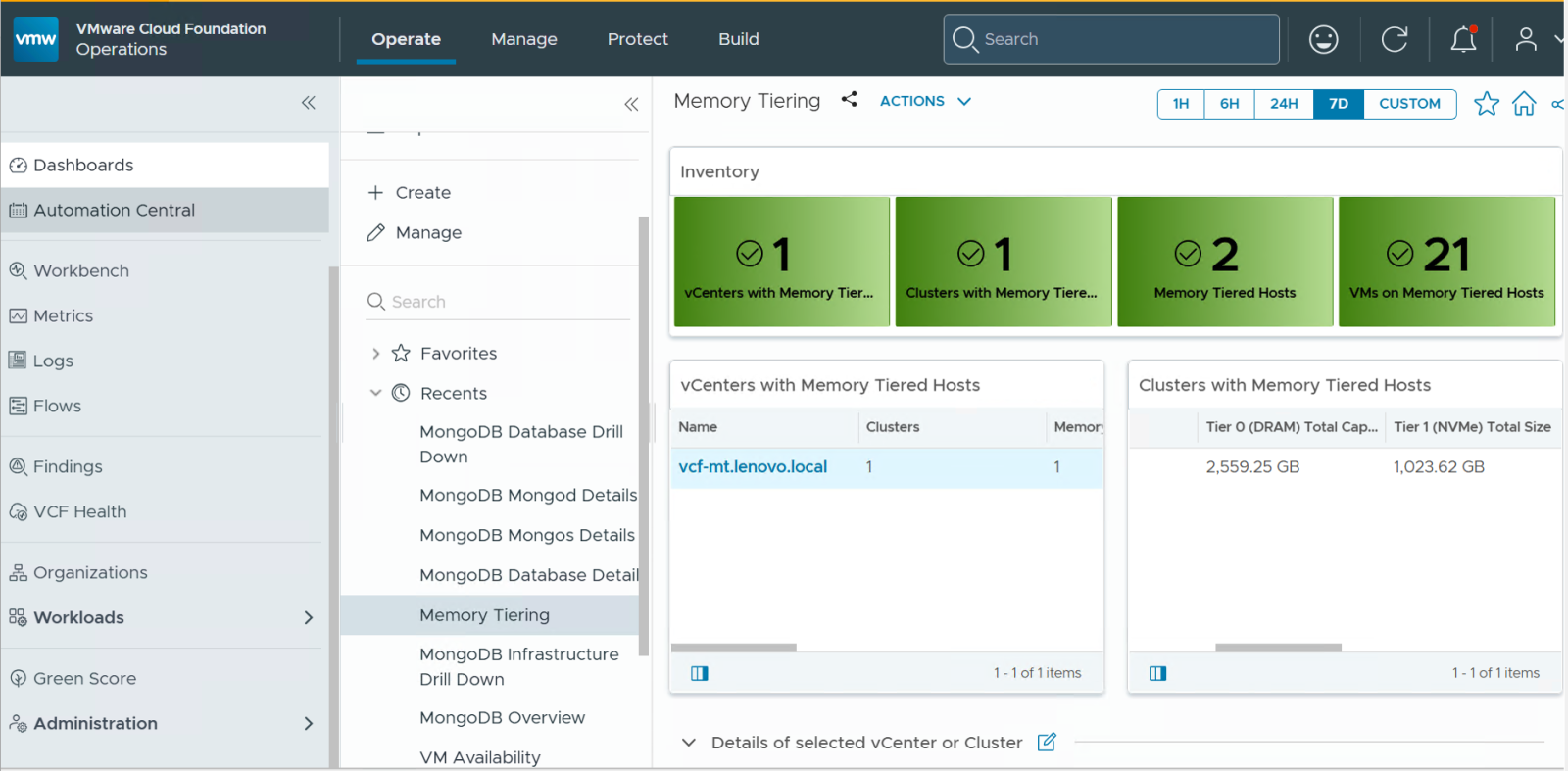
Once tiering is enabled, VCF Operations provides a dedicated Memory Tiering dashboard with per-VM tier bandwidth, latency, and consumed memory for day-to-day monitoring, while Distributed Resource Scheduler, high availability, and vMotion keep workloads balanced. Lenovo lifecycle services then cover deployment, support, and ongoing updates under a single point of contact, so teams gain the density and cost benefits without added operational overhead.
Use Cases
Memory Tiering delivers the most value for workloads that reserve far more memory than they actively use at any given moment. The scenarios below are the highest value deployment targets validated on VCF 9.1 and Lenovo ThinkAgile VX V4, spanning virtual desktops and databases.
- Virtual Desktop Knowledge worker
Knowledge worker virtual desktops typically require only 4 to 8 GB of memory and remain idle for extended periods between bursts of user activity. With Memory Tiering, VX V4 nodes keep active desktop memory pages in DRAM while transparently moving inactive pages to NVMe storage. This optimization enables up to 2x higher desktop density per node without significantly impacting user experience. Login Enterprise testing at double the desktop density demonstrated only a 10% impact on end-user experience scores, which remains well within acceptable thresholds for VDI deployments, delivering improved infrastructure efficiency and a better return on investment.
- SQL Server OLTP Transactional
SQL Server databases are designed to utilize available memory efficiently to maximize performance. However, the amount of active memory required for transaction processing varies based on database size, working set, transaction volume, the number of concurrent users, and workload intensity. Memory tiering with NVMe enables approximately 1.5x to 2x higher consolidation for different OLTP scenarios on standalone deployment while maintaining acceptable throughput and latency tradeoffs. This approach helps maximize ROI by improving resource utilization across both horizontal and vertical scaling of SQL Server instances.
- MongoDB NoSQL Memory Bound CRUD Operations
MongoDB performance, when heavily memory-bound, can be optimized by using NVMe memory tiering to extend the effective capacity beyond physical DRAM. This approach keeps hot data in DRAM while tiering cooler data to NVMe, preventing severe, high-latency disk thrashing. The strategy allows for higher VM consolidation density and reduced infrastructure costs, while maintaining acceptable throughput for mixed CRUD workloads. The WiredTiger engine and OS cache utilize this extended memory to sustain performance, making it an effective, cost-efficient solution for memory-constrained environments.
Workloads
Lenovo and VMware validated Memory Tiering across a range of enterprise workloads on the ThinkAgile VX650 V4, a 2U dual socket platform with Intel Xeon 6700P or 6500P processors, up to 8 TB of DDR5, and 24 PCIe 5.0 NVMe bays. All results below are at twice the virtual machine density of an all DRAM baseline:
- Virtual desktops: Login Enterprise 5.14, 0 to 8 percent performance impact.
- Databases: HammerDB 5.0 on SQL Server 2022 at twice the density, with 0 to 5 percent performance impact; SQL Server and MongoDB are common Memory Tiering consolidation targets.
- Sizing guidance: use high endurance NVMe (3 DWPD or higher), keep host CPU utilization below 75 percent, and avoid virtual machines larger than 32 vCPUs or 512 GB in tiered configurations.
Memory Tiering is the strongest fit when host memory, not CPU, is the constraint and the active working set stays at or below roughly 50 percent of DRAM, so hot pages remain in Tier 0 and only latency-tolerant cold pages move to NVMe. It is not recommended for latency-critical workloads where nearly every page is hot, or where the active working set exceeds available DRAM.
Test Results
Lenovo and Intel engineering teams validated VCF 9.1 Memory Tiering on Lenovo ThinkAgile VX V4 across three representative workloads, each tested at double the virtual machine density of a DRAM-only baseline using the default 1:1 DRAM-to-NVMe ratio.
Across all three workloads, Memory Tiering roughly doubled consolidation while retaining the majority of performance, with host CPU utilization staying within recommended ranges. Knowledge worker VDI showed the smallest impact, since idle desktop memory tiers efficiently to NVMe. Full hardware configurations, workload parameters, and per-scenario analysis are available in the companion Lenovo reference architecture.
Business Outcome
Deploying VCF 9.1 Memory Tiering on ThinkAgile VX V4 produces measurable results across cost, capacity, and efficiency. Because NVMe costs roughly 4 to 6 times less per GB than DDR5 DRAM, doubling addressable memory in software rather than hardware drives most of the savings:
- Up to 45 percent lower infrastructure total cost of acquisition for the same virtual machine capacity.
- 2x virtual machine density per host with more than 90 percent performance retention.
- Up to 50 percent fewer physical servers by consolidating twice the virtual machines per node.
- More than 50 percent faster Memory Tiering configuration in VCF 9.1, with no host reboot required.
As a published VMware example, reaching 2 TB of effective memory per node with tiering, using 1 TB of DRAM plus a 1 TB NVMe tier, costs roughly 205,000 dollars compared with about 318,000 dollars for an all-DRAM 2 TB node. That is the same effective capacity for close to 40 percent less, before the additional savings in power, cooling, and rack space from deploying fewer servers.
In sustained testing, active memory stayed below 50 percent of DRAM capacity and NVMe read latency held between 100 and 200 microseconds, within VMware's recommended range. Published figures are based on Lenovo and VMware benchmark testing; actual results vary by workload and configuration.
Conclusion
VCF 9.1 Memory Tiering on Lenovo ThinkAgile VX V4 with Intel Xeon 6 lets organizations double virtual machine density and cut infrastructure cost by up to 45 percent while keeping performance close to an all DRAM baseline. With software NVMe mirroring, single workflow configuration, and deeper observability, Memory Tiering is ready for production across virtual desktops, databases, and enterprise applications. Lenovo delivers factory integrated VX V4 systems preconfigured for VCF 9.1, so teams can adopt tiering with validated firmware, drivers, and support from day one.
For More Information
To learn more about VMware Memory Tiering on Lenovo ThinkAgile VX V4, contact your Lenovo representative or Lenovo Business Partner, or visit the resources below.
References:
- Lenovo ThinkAgile VX Series:
https://www.lenovo.com/us/en/servers-storage/hyperconverged/thinkagile-vx/ - Lenovo Press: ThinkAgile VX Series product guides:
https://lenovopress.lenovo.com/servers/thinkagile/vx - VMware Cloud Foundation:
https://www.vmware.com/products/cloud-infrastructure/vmware-cloud-foundation - Micron 7600 Data Center SSD:
https://www.micron.com/products/storage/ssd/data-center-ssd/7600-ssd - NAND Research, Memory and NAND Flash Crisis (May 2026):
https://nand-research.com/memory-nand-flash-crisis-may-2026-update/ - Server Space, Why Server Hardware Is Getting More Expensive in 2026 (August 2026):
https://serverspace.us/about/blog/why-server-hardware-is-getting-more-expensive-in-2026-and-what-you-can-do-about-it/
Authors
Markesha Parker is the WW Technical Leader for ThinkgAgile VX Hyper-Converged solutions at Lenovo. In this role, she works to deliver quality solutions integrating Lenovo and third party hardware and software. She defines the technical requirements to enable manufacturing, support, and technical sales. Markesha has worked in the IT industry for over 17 years and is currently based in Morrisville, NC.
Chandrakandh Mouleeswaran is a Solution Architect with 18+ years of experience in software development, performance testing and engineering, having worked on designing and architecting many scalable enterprise applications. He has spent a decade in technical enablement and partner solution development for VMware, Nutanix, Oracle and other ISVs across industries and technologies. He specializes in architecting infrastructure solutions for virtualization, VDI, database, cloud, data science, AI/ML solutions and various enterprise workloads.
Cristian Ghetau is an Advisory Engineer for Lenovo in Romania and has experience in Cloud Infrastructure technologies. He has had more than 13 years of experience working with virtual environments from VMware, Microsoft, Oracle, and Linux.
Catherine Maina is a Senior Product Manager for ThinkAgile VX at Lenovo, where she leads portfolio strategy and market direction for VMware based hyperconverged and software defined infrastructure platforms. She works across engineering, sales, marketing, and ecosystem partners to shape co engineered solutions that support modern hybrid cloud architectures, balancing scalability and operational simplicity for enterprise customers.
Chris Honoré is a Solutions Product Manager at Lenovo with deep expertise in datacenter products and solution offerings. He has a strong background in consulting and solution development, helping customers design and support on-premises and hybrid environments. Chris has spent the past 15 years with IBM and Lenovo, specializing in x86 server and data center solutions. Prior to that, he built two decades of experience in the telecommunications industry, serving in both technical and business leadership roles.
Trademarks
Lenovo and the Lenovo logo are trademarks or registered trademarks of Lenovo in the United States, other countries, or both. A current list of Lenovo trademarks is available on the Web at https://www.lenovo.com/us/en/legal/copytrade/.
The following terms are trademarks of Lenovo in the United States, other countries, or both:
Lenovo®
ThinkAgile®
The following terms are trademarks of other companies:
AMD and AMD EPYC™ are trademarks of Advanced Micro Devices, Inc.
Intel®, the Intel logo and Xeon® are trademarks of Intel Corporation or its subsidiaries.
SQL Server® is a trademark of Microsoft Corporation in the United States, other countries, or both.
TPC® and TPC-C® are trademarks of Transaction Processing Performance Council.
Other company, product, or service names may be trademarks or service marks of others.
Configure and Buy
Please select a locale
Full Change History
Course Detail
Employees Only Content
The content in this document with a is only visible to employees who are logged in. Logon using your Lenovo ITcode and password via Lenovo single-signon (SSO).
The author of the document has determined that this content is classified as Lenovo Internal and should not be normally be made available to people who are not employees or contractors. This includes partners, customers, and competitors. The reasons may vary and you should reach out to the authors of the document for clarification, if needed. Be cautious about sharing this content with others as it may contain sensitive information.
Any visitor to the Lenovo Press web site who is not logged on will not be able to see this employee-only content. This content is excluded from search engine indexes and will not appear in any search results.
For all users, including logged-in employees, this employee-only content does not appear in the PDF version of this document.
This functionality is cookie based. The web site will normally remember your login state between browser sessions, however, if you clear cookies at the end of a session or work in an Incognito/Private browser window, then you will need to log in each time.
If you have any questions about this feature of the Lenovo Press web, please email David Watts at dwatts@lenovo.com.


