

Top
Author
Published
24 Jun 2026Form Number
LP2455PDF size
11 pages, 394 KBSubscribed to LP2455.
Thank you for your feedback.
Abstract
The Lenovo ThinkSystem SR650 V4 with Intel Xeon 6 processors, deployed on Red Hat OpenShift, addresses the infrastructure challenges of scaling agentic AI workloads such as document summarization and contract analysis. Validated testing shows two SR650 V4 servers deliver up to 2.4x higher AI throughput than four previous-generation SR650 V3 servers, consistently across all concurrent user loads (32-128 users), while cutting server count in half — translating into lower cost, reduced CapEx, and greater sustainability.
These gains are demonstrated across use cases in financial services, healthcare, legal, manufacturing, public sector, and enterprise knowledge management, positioning the SR650 V4 as a validated, cost-efficient foundation for enterprise-scale agentic AI.
Introduction
Deliver up to 2.4x higher AI throughput at significantly lower infrastructure cost with fewer servers running on Red Hat OpenShift.
Enterprise IT leaders are under increasing pressure to support rapidly expanding AI workloads while keeping infrastructure costs under control. As organizations move beyond experimentation and into production-scale deployment of Generative AI (GenAI), the infrastructure decisions they make today will define their competitive position for years to come.
Agentic AI is a class of AI systems capable of autonomously executing multi-step workflows, reasoning over documents, and generating actionable insights. It represents one of the most transformative and compute-intensive enterprise use cases. Workloads such as automated document summarization, contract analysis, and intelligent process automation demand both high throughput and consistent responsiveness as concurrent user loads scale across the organization.
This solution brief examines how the Lenovo ThinkSystem SR650 V4, powered by Intel Xeon 6 processors and deployed on a Red Hat OpenShift cluster, delivers a validated, high-performance platform for agentic AI at enterprise scale. The findings are drawn from rigorous performance testing of end-to-end document summarization workloads - a real-world proxy for the types of GenAI tasks organizations are deploying today.
The Challenge
Enterprises need a platform that delivers superior AI throughput with fewer servers - reducing cost, complexity, and the carbon footprint of production AI deployments.
Agentic AI is transforming enterprise operations by enabling the automation of complex workflows and generating actionable insights that improve productivity and accelerate innovation.
However, deploying GenAI at scale often presents significant infrastructure challenges:
- Infrastructure efficiency - scaling AI workloads without proportionally scaling hardware spend
- Cost optimization - managing rising expenses as compute demands fluctuate
- Operational complexity - maintaining reliable support for production AI applications
- Performance consistency - ensuring responsiveness as concurrent user loads increase
Organizations evaluating on-premises AI infrastructure face a difficult tradeoff: deploying too little hardware risks performance degradation during peak loads, while over-provisioning drives up capital and operational expenditure. Previous-generation server platforms often required significant scale-out to meet throughput targets, multiplying rack space, power draw, cooling costs, and management complexity.
The Solution
Lenovo ThinkSystem SR650 V4 servers with Intel Xeon 6 processors deliver a purpose-built platform for enterprise AI workloads — combining cutting-edge silicon performance with Lenovo's proven server engineering.
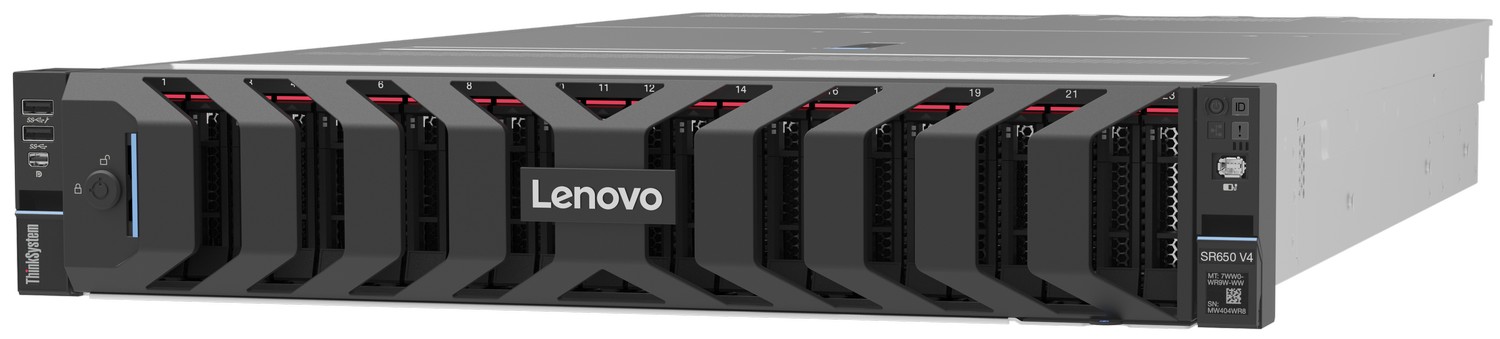
Figure 1. Lenovo ThinkSystem SR650 V4
Deployed as a Red Hat OpenShift cluster, this solution enables organizations to run agentic document summarization and other GenAI workflows with outstanding efficiency. Intel's latest generation Xeon 6 processors deliver significant gains through:
- Faster cores with higher clock speeds for demanding AI inference tasks
- Larger cache capacity and increased memory bandwidth for large model throughput
- DDR5 support and high-bandwidth memory capabilities
- Improved performance-per-watt to control power and cooling costs
Performance Results
In validated testing, two Lenovo ThinkSystem SR650 V4 servers with Intel Xeon 6 processors consistently outperformed four SR650 V3 servers with 5th Gen Intel Xeon processors across every user load tested from 32 to 128 concurrent users. This means IT organizations can achieve superior AI performance while cutting server count in half.
The figure below shows normalized throughput (requests per second) for an agentic document summarization workload on a Red Hat OpenShift cluster, as concurrent users requesting summaries scale from 32 to 128.
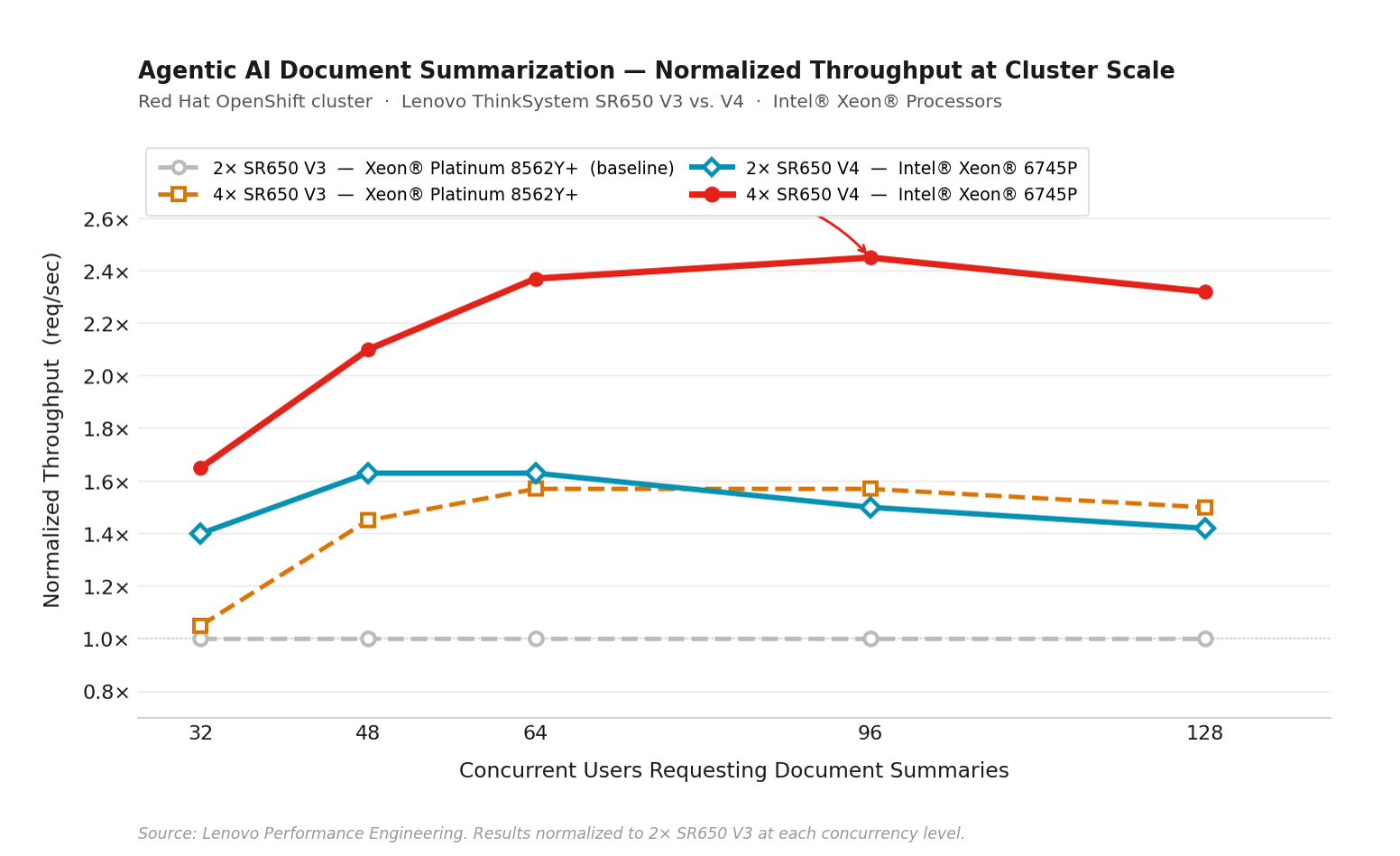
Figure 2. Normalized throughput for end-to-end document summarization at cluster scale.
Throughput is normalized against a baseline of two SR650 V3 servers with 5th Gen Intel Xeon Platinum 8562Y+ processors (1.0x). Four SR650 V3 servers with the same processors reach roughly 1.6x throughput at peak. By comparison, two Lenovo ThinkSystem SR650 V4 servers with Intel Xeon 6745P processors deliver up to ~1.7x throughput, and four SR650 V4 servers scale to as much as 2.4x — demonstrating substantial throughput gains and improved cost efficiency per server with the new platform.
Key Findings
Two SR650 V4 servers with Intel Xeon 6 outperformed four SR650 V3 servers at every load point tested - delivering 2.4x higher throughput with half the hardware footprint.
Two SR650 V4 servers with Intel Xeon 6 processors consistently outperformed four SR650 V3 servers across every user load tested, from 32 to 128 concurrent users:
- Up to 2.4x higher normalized throughput (requests per second) for end-to-end document summarization at cluster scale
- Superior performance achieved with 50% fewer physical servers - 2 SR650 V4 units versus 4 SR650 V3 units
- Consistent throughput advantage maintained across all concurrent user loads tested (32-128 users)
- Significantly lower infrastructure cost for each unit of AI processing capacity delivered.
Why Lenovo ThinkSystem SR650 V4
The Lenovo ThinkSystem SR650 V4 is a purpose-engineered 2U rack server that combines Intel's latest silicon advances with Lenovo's proven server engineering - creating a platform optimized for the demands of enterprise AI at scale.
Intel's latest generation Xeon 6 processors deliver significant architectural gains that translate directly into AI inference performance:
- Faster cores with higher clock speeds purpose-built for demanding AI inference tasks
- Larger cache capacity and increased memory bandwidth to sustain throughput for large language model inferencing
- DDR5 and high-bandwidth memory support enabling faster data movement between CPU and memory
- Improved performance-per-watt to control power and cooling costs at data center scale
Advanced Cooling Options
For customers seeking greater efficiency than traditional air cooling, the Lenovo Processor Neptune Core Module offers an open-loop liquid cooling alternative. By removing processor heat more effectively, it reduces reliance on server fans and data center air conditioning, lowering energy consumption and operating costs. Depending on the configuration, organizations can achieve up to 63% fan power savings per node and nearly 25% rack-level power savings.
Simplified Infrastructure Management
Lenovo XClarity complements the SR650 V4 with a unified infrastructure management platform that leverages AI-driven monitoring and automation to reduce downtime and streamline operations. With centralized visibility, Zero Trust security, support for open standards, and flexible cloud or on-premises deployment options, XClarity enables organizations to manage and scale their infrastructure with greater efficiency, security, and operational simplicity.
The following table lists the specifications of the ThinkSystem SR650 V4.
Key Solution Benefits
The key benefits of the SR650 V4 platform include the following:
- Superior Throughput
2.4x higher AI request throughput versus prior-generation platform, sustained across all concurrency levels tested
- Fewer Servers
Achieve production AI throughput targets with 50% fewer physical servers, reducing rack space, cabling, and per-node management overhead
- Lower Total Cost
Significantly reduced infrastructure cost per unit of AI throughput; fewer servers means lower CapEx, power, and cooling spend
- Scalability
Performance advantage holds and grows as concurrent user loads scale from 32 to 128+ users - validated on Red Hat OpenShift
- Sustainability
Lenovo Neptune cooling and ENERGY STAR-compliant designs enable up to 3:1 rack consolidation and reduced PUE impact
- Enterprise Management
XClarity One provides centralized control, SSD failure prediction, and federated directory for simplified operations
- Future-Ready
PCIe Gen5, CXL 2.0, MRDIMM, and up to 8TB memory support protect infrastructure investments against emerging AI workload requirements
Business Outcomes
Organizations that deploy agentic AI on the ThinkSystem SR650 V4 realize measurable improvements across three dimensions: performance, economics, and operational efficiency.
- Higher Employee Productivity
Automating document-intensive workflows - summarization, contract review, compliance checking - frees knowledge workers from time-consuming manual tasks. Requests that previously required 15-30 minutes of human effort are completed in seconds at scale.
- Faster Time-to-Insight
With 2.4x higher throughput, AI inference results are returned faster across all concurrent users. Teams acting on AI-generated insights move more quickly from analysis to decision.
- Reduced Infrastructure CapEx
Achieving the same or better throughput with 50% fewer servers translates directly to lower hardware acquisition costs. A deployment that previously required 4 servers requires only 2, cutting procurement, rack, and cabling costs in half.
- Lower Operational Costs
Fewer physical servers mean reduced power consumption, cooling load, and software licensing fees. Lenovo Neptune thermal efficiency and ENERGY STAR compliance further reduce per-server energy costs.
- Improved IT Agility
A smaller, higher-performing cluster is easier to manage, patch, and scale. XClarity One provides AI-predictive management, reducing mean time to resolution and lowering IT labor costs.
- Faster ROI on AI Investment
By consolidating AI infrastructure onto fewer, more capable servers, organizations accelerate payback on their AI platform investment - freeing savings to fund additional AI use cases.
- Future-Proof Platform
PCIe Gen5, CXL 2.0, MRDIMM support, and up to 8TB memory capacity accommodate next-generation AI models and expanding workload requirements without a full infrastructure refresh.
Customer Use Cases
The ThinkSystem SR650 V4 is validated for production-scale agentic AI deployments across industries where document intelligence, workflow automation, and real-time AI reasoning deliver measurable business value.
From financial services to healthcare to manufacturing, the SR650 V4 delivers the throughput, scalability, and on-premises security posture that enterprise agentic AI demands.
Conclusion
The results are clear: the Lenovo ThinkSystem SR650 V4 with Intel Xeon 6 processors delivers outstanding throughput and cost efficiency for agentic AI workloads at enterprise scale. By achieving up to 2.4x higher throughput with half the server footprint compared to the previous generation, organizations can scale AI deployments more effectively, reduce infrastructure costs, and bring transformative agentic AI capabilities to production faster. Deployed on Red Hat OpenShift, the SR650 V4 provides a validated, enterprise-grade foundation for the full spectrum of GenAI workloads - from document summarization and contract analysis today, to more complex autonomous agent workflows as AI capabilities continue to evolve.
For organizations evaluating infrastructure investments for AI at scale, the ThinkSystem SR650 V4 platform represents a compelling path to achieving more with fewer resources: higher performance, lower cost, and a simpler operational footprint - delivered by the trusted combination of Lenovo engineering and Intel Xeon 6 silicon.
Ready to accelerate your agentic AI deployment? Contact your Lenovo representative or go to the ThinkSystem SR650 V4 product web page to learn more about the server.
Author
Chris Honoré is a Solutions Product Manager at Lenovo with deep expertise in datacenter products and solution offerings. He has a strong background in consulting and solution development, helping customers design and support on-premises and hybrid environments. Chris has spent the past 15 years with IBM and Lenovo, specializing in x86 server and data center solutions. Prior to that, he built two decades of experience in the telecommunications industry, serving in both technical and business leadership roles.
Trademarks
Lenovo and the Lenovo logo are trademarks or registered trademarks of Lenovo in the United States, other countries, or both. A current list of Lenovo trademarks is available on the Web at https://www.lenovo.com/us/en/legal/copytrade/.
The following terms are trademarks of Lenovo in the United States, other countries, or both:
Lenovo®
Neptune®
ThinkSystem®
XClarity®
The following terms are trademarks of other companies:
Intel®, the Intel logo and Xeon® are trademarks of Intel Corporation or its subsidiaries.
Microsoft® is a trademark of Microsoft Corporation in the United States, other countries, or both.
Other company, product, or service names may be trademarks or service marks of others.
Configure and Buy
Please select a locale
Full Change History
Course Detail
Employees Only Content
The content in this document with a is only visible to employees who are logged in. Logon using your Lenovo ITcode and password via Lenovo single-signon (SSO).
The author of the document has determined that this content is classified as Lenovo Internal and should not be normally be made available to people who are not employees or contractors. This includes partners, customers, and competitors. The reasons may vary and you should reach out to the authors of the document for clarification, if needed. Be cautious about sharing this content with others as it may contain sensitive information.
Any visitor to the Lenovo Press web site who is not logged on will not be able to see this employee-only content. This content is excluded from search engine indexes and will not appear in any search results.
For all users, including logged-in employees, this employee-only content does not appear in the PDF version of this document.
This functionality is cookie based. The web site will normally remember your login state between browser sessions, however, if you clear cookies at the end of a session or work in an Incognito/Private browser window, then you will need to log in each time.
If you have any questions about this feature of the Lenovo Press web, please email David Watts at dwatts@lenovo.com.


