

Top
Author
Published
30 Apr 2026Form Number
LP2430PDF size
10 pages, 373 KBSubscribed to LP2430.
Thank you for your feedback.
Table of Contents
Abstract
This solution provides a flexible, scalable, and cost‑efficient on‑premises foundation for enterprise risk management (ERM) by consolidating enterprise‑wide risk and compliance functions into a single, integrated management platform.
The architecture is based on a Red Hat OpenShift Compact Cluster deployed on Lenovo ThinkSystem SR630 V4 servers, supporting either locally attached server storage or centralized external storage using a Lenovo ThinkSystem DM5200H or DG5200 Storage Array.
Business Challenge
As regulatory demands, cyber threats, and geopolitical risks continue to increase, organizations require a more integrated and controlled approach to Governance, Risk, and Compliance (GRC) while maintaining full ownership of their data. IBM OpenPages provides an enterprise‑grade, AI‑enabled GRC platform that consolidates compliance, operational, cyber, and third‑party risk management into a unified system of record.
By eliminating organizational silos, automating manual workflows, and delivering actionable, risk‑based insights, OpenPages enables real‑time visibility into enterprise risk. This supports stronger compliance assurance, faster and more informed decision‑making, and a resilient, proactive risk management posture across complex, global organizations.
Solution Overview
IBM OpenPages is deployed as a cloud‑native GRC application on IBM Cloud Pak for Data (CP4D), which is built on Red Hat OpenShift to provide a secure, portable, and centrally managed governance platform for on‑premises, hybrid, and public cloud environments.
Lenovo’s IBM OpenPages solution integrates Red Hat OpenShift cloud‑native containerization with enterprise‑class Lenovo compute and storage systems, delivering a validated, high‑performance infrastructure foundation for running OpenPages at scale.
Top-Down Solution Layers
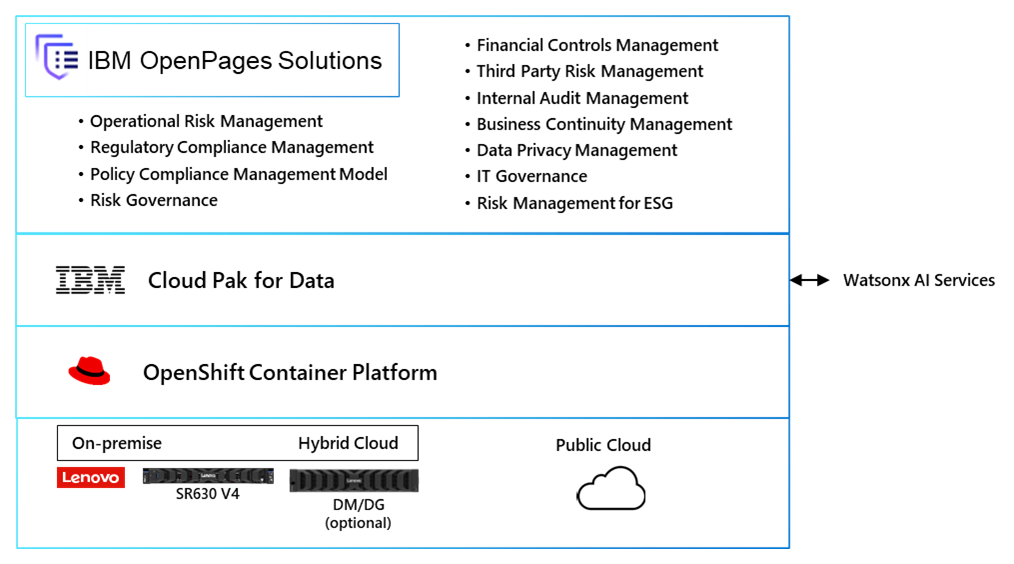
Key components of the solution are the following, as shown in the figure below:
- Application Layer - IBM OpenPages: IBM OpenPages is a cloud‑native, containerized Governance, Risk, and Compliance (GRC) application that delivers enterprise risk, compliance, and regulatory management through a unified Enterprise Risk Management (ERM) platform. Deployed as a service within IBM Cloud Pak for Data (CP4D), it represents the primary application layer consumed by business users.
IBM OpenPages can operate alongside other CP4D services, including IBM watsonx AI services, enabling integrated ERM workflows, advanced analytics, and AI‑driven risk insights within a shared, governed platform.
- Software Platform Layer - IBM Cloud Pak for Data: IBM Cloud Pak for Data (CP4D) serves as the common platform and centralized control plane for the solution. It provides shared platform services including identity and access management, database and storage integration, governance and security controls, lifecycle management, monitoring, backup, and high‑availability capabilities, as well as access to IBM watsonx AI services (subject to watsonx entitlement).
CP4D also orchestrates service installation, upgrades, and compatibility across Red Hat OpenShift versions and acts as the licensing and entitlement mechanism through which IBM OpenPages is deployed and managed in self‑managed environments.
- Container Layer - Red Hat OpenShift: Red Hat OpenShift is the required container platform for IBM Cloud Pak for Data and, by extension, for self‑managed IBM OpenPages deployments. It delivers enterprise Kubernetes capabilities including container orchestration, networking, persistent storage integration, security enforcement, and high availability. OpenShift also provides a consistent and supported runtime environment across on‑premises and public cloud infrastructures, ensuring portability and operational consistency.
- Infrastructure Layer - Customer Infrastructure: IBM OpenPages is deployed as a containerized GRC service on IBM Cloud Pak for Data, using Red Hat OpenShift to provide container orchestration, scalability, and platform resilience. The solution can be deployed on customer‑owned infrastructure, supporting on‑premises, hybrid, and public cloud environments while maintaining consistent operational and architectural behavior.
This Lenovo solution supports on‑premises and hybrid cloud deployments using a Red Hat OpenShift Compact Cluster architecture built on Lenovo ThinkSystem servers. It can be configured with either locally attached server storage or external Lenovo ThinkSystem storage, allowing customers to start with a minimal footprint and scale incrementally as capacity and performance requirements grow.
IBM OpenPages
The IBM OpenPages Governance, Risk, and Compliance platform delivers the following enterprise risk management solutions:
- IBM OpenPages ORM delivers an integrated operational risk solution covering RCSAs, KRIs, loss events, advanced reporting, dashboards, and Basel II AMA compliance.
- Business Continuity Management (BCM) helps organizations maintain or restore operations during and after disruptive events by identifying related risks.
- Data Privacy Management (DPM) supports compliance with data privacy regulations by providing visibility into sensitive data and ensuring proper handling.
- Risk Management for ESG enables organizations to manage environmental, social, and governance priorities, objectives, and compliance.
- Financial Controls Management (FCM) streamlines compliance efforts for financial reporting regulations, reducing time and cost.
- Model Risk Governance (MRG) centralizes and manages an organization’s model inventory.
- Policy Management (PCM) simplifies compliance with industry, ethics, privacy, and government regulations.
- IT Governance (ITG) provides a risk-based, policy-driven approach to IT risk and compliance.
- Internal Audit Management (IAM) manages the complete internal audit lifecycle.
- Regulatory Compliance Management (RCM) breaks regulations into actionable requirements and tasks.
- Third Party Risk Management (TPRM) helps assess and manage risks associated with vendors and third parties.
IBM Cloud Pak for Data
Built on Red Hat OpenShift, IBM Cloud Pak for Data (CP4D) leverages Kubernetes-based container orchestration to ensure portability, scalability, resilience, and consistent operations regardless of where it is deployed. This design allows organizations to deploy CP4D on‑premises, in private clouds, on public cloud infrastructure, or across hybrid and multicloud landscapes while maintaining the same tools, APIs, security model, and lifecycle management processes.
CP4D supports both traditional analytics (BI, SQL analytics, and reporting) and advanced AI/ML workflows, including automated machine learning (AutoAI) and scalable model deployment through Watson Machine Learning. Models developed on CP4D can be deployed as containerized microservices running directly on OpenShift, allowing them to scale elastically and integrate seamlessly into business applications and operational systems.
Red Hat OpenShift Container Platform
Red Hat OpenShift Container Platform is an enterprise-grade Kubernetes application platform that extends upstream Kubernetes with integrated developer, operational, security, and lifecycle management capabilities. It provides a consistent, secure, and scalable foundation for building, deploying, and operating cloud‑native applications across on‑premises, private cloud, public cloud, and hybrid/multicloud environments.
OpenShift is positioned above raw Kubernetes, acting as a full container application platform rather than a container orchestrator alone.
Key advantage - Platform Consistency Across Hybrid Cloud
The same Red Hat OpenShift platform is used consistently across on‑premises, public cloud, and edge or disconnected environments.
This uniformity provides a predictable runtime, consistent operations, and simplified lifecycle management, which is why IBM has standardized platforms such as Cloud Pak for Data, IBM OpenPages, and watsonx on OpenShift.
What Is an OpenShift Compact Cluster?
A Compact Cluster is a cost‑ and footprint‑optimized OpenShift deployment model where control plane and worker roles are combined on typically 3 nodes (minimum). Each node runs the control plane components and the application workloads.
Even as a compact cluster, OpenShift still provides production‑grade High Availability (despite its smaller size) as it delivers:
- etcd quorum (3 nodes)
- control plane HA
- pod replication
- self‑healing workloads
Red Hat OpenShift provides a secure, enterprise‑grade Kubernetes platform for hybrid cloud, and the OpenShift compact cluster offers full production HA with a minimal footprint, making it ideal for cost‑efficient, regulated deployments of platforms like IBM Cloud Pak for Data and OpenPages.
Lenovo ThinkSystem Foundation
The Lenovo ThinkSystem SR630 V3 is a 2‑socket, 1U rack server optimized for dense, scale‑out OpenShift containerization, delivering high virtual machine density, balanced CPU, memory, and I/O performance for mixed workloads, and an ideal fit for three‑node compact OpenShift cluster deployments.

Figure 2. Lenovo ThinkSystem SR630 V4
Lenovo’s 4th Generation ThinkSystem servers deliver a high‑performance and highly reliable infrastructure foundation for this solution. The ThinkSystem SR630 V4 is a compact 1U, dual‑socket server powered by Intel Xeon 6 processors (6500 and 6700 series), supporting up to 86 cores per CPU and up to 8 TB of memory per server, enabling exceptional containerization density.
The platform is equipped with modern capabilities such as PCIe Gen5 expansion, NVMe storage support, and Lenovo XClarity Controller for enterprise‑grade out‑of‑band management, ensuring optimal performance, simplified operations, and efficient lifecycle management.
In this solution, Red Hat OpenShift Containerization runs on a three‑node Lenovo ThinkSystem SR630 V4 cluster, forming a compact hyperconverged infrastructure where each node provides integrated compute, storage, and networking, enabling simple and scalable growth.
Rather than relying on local storage, this solution can also be deployed using an external enterprise storage system which is especially relevant for IBM OpenPages, where data durability and auditability are critical.

Figure 3. Lenovo ThinkSystem DM5200H and DG5200
Lenovo ThinkSystem DM5200H and DG5200 Storage Arrays provide the resilient, compliant, and CP4D‑aligned data foundation that IBM OpenPages requires to operate as a mission‑critical enterprise GRC platform.
DM5200H and DG5200 Storage Arrays are integrated with OpenShift using a Container Storage Interface (CSI) driver, which is the required and supported method for external storage with OpenShift and OpenShift Containerization.
OpenShift Compact Cluster Sizing for IBM OpenPages Deployments
Three‑node, four-node and five-node Lenovo ThinkSystem SR630 V4 OpenShift compact clusters are appropriately sized to support IBM OpenPages GRC deployments. These configurations are targeting up to 250 (small), up to 500 (medium) or up to 750 (large) concurrent users respectively, when configured in line with IBM Cloud Pak for Data and Red Hat OpenShift best practices and subject to workload characteristics and growth assumptions.
| Configuration Size | Number of Servers | Concurrent Users (up to) |
|---|---|---|
| Small | 3 | 250 |
| Medium | 4 | 500 |
| Large | 5 | 750 |
The key components per server using internal storage are listed in the following table.
Optionally, the 3.2TB NVMe drives can be removed from the servers and an DM5200H or DG5200 external storage array can be used instead.
This infrastructure for this solution can be configured by using the Lenovo Data Center Solution Configurator (DCSC).
Benefits of the Lenovo ThinkSystem Platform for IBM OpenPages
The benefits of the Lenovo ThinkSystem platform for IBM OpenPages include the following:
- Trusted Lenovo Infrastructure for Mission‑Critical GRC
Lenovo ThinkSystem servers and enterprise storage provide a resilient, enterprise‑grade foundation designed for always‑on Governance, Risk, and Compliance workloads.
- High Performance with Compact, Cost‑Efficient Footprint
ThinkSystem SR630 V4 servers enable high containerization density and balanced performance, supporting a 3‑node Red Hat OpenShift Compact Cluster with full production‑grade high availability at lower cost.
- Enterprise Storage Built for Auditability and Compliance
Lenovo ThinkSystem DM5200H/DG5200 Storage Arrays deliver durable, highly available, CSI‑integrated storage aligned to IBM OpenPages’ requirements for data integrity, auditability, and compliance.
- Full Data Sovereignty on Customer‑Owned Systems
By running IBM OpenPages on Lenovo infrastructure on‑premises, organizations retain complete control over sensitive risk and compliance data while meeting strict regulatory and residency requirements.
- Future‑Proof Platform for Hybrid Cloud Expansion
Lenovo ThinkSystem hardware consistently supports Red Hat OpenShift and IBM Cloud Pak for Data across on‑premises and hybrid environments, protecting infrastructure investment over time.
Related publications
For more information, see these resources:
- IBM OpenPages:
https://www.ibm.com/products/openpages - IBM Cloud Pak for Data:
https://www.ibm.com/products/cloud-pak-for-data - Red Hat OpenShift Containerization:
https://www.redhat.com/openshift - Red Hat OpenShift Compact Cluster:
https://www.redhat.com/en/blog/delivering-a-three-node-architecture-for-edge-deployments
Author
Martin Herzog is a Solution Manager for Enterprise IT Solutions at Lenovo, with over 18 years of experience in the SAP ecosystem. Previously, he was the Product Manager for Lenovo's SAP solutions and worked in other SAP-related positions. Martin has started his professional career at IBM in 1997 and has held various technical roles. He is based in Walldorf in Germany and holds a master degree in Electrical Engineering from the University of Darmstadt (Germany).
Trademarks
Lenovo and the Lenovo logo are trademarks or registered trademarks of Lenovo in the United States, other countries, or both. A current list of Lenovo trademarks is available on the Web at https://www.lenovo.com/us/en/legal/copytrade/.
The following terms are trademarks of Lenovo in the United States, other countries, or both:
Lenovo®
ThinkSystem®
XClarity®
The following terms are trademarks of other companies:
Intel®, the Intel logo and Xeon® are trademarks of Intel Corporation or its subsidiaries.
IBM®, IBM Cloud®, IBM Cloud Pak®, IBM watsonx®, ibm.com®, OpenPages®, and watsonx® are trademarks of IBM in the United States, other countries, or both.
Other company, product, or service names may be trademarks or service marks of others.
Configure and Buy
Please select a locale
Full Change History
Course Detail
Employees Only Content
The content in this document with a is only visible to employees who are logged in. Logon using your Lenovo ITcode and password via Lenovo single-signon (SSO).
The author of the document has determined that this content is classified as Lenovo Internal and should not be normally be made available to people who are not employees or contractors. This includes partners, customers, and competitors. The reasons may vary and you should reach out to the authors of the document for clarification, if needed. Be cautious about sharing this content with others as it may contain sensitive information.
Any visitor to the Lenovo Press web site who is not logged on will not be able to see this employee-only content. This content is excluded from search engine indexes and will not appear in any search results.
For all users, including logged-in employees, this employee-only content does not appear in the PDF version of this document.
This functionality is cookie based. The web site will normally remember your login state between browser sessions, however, if you clear cookies at the end of a session or work in an Incognito/Private browser window, then you will need to log in each time.
If you have any questions about this feature of the Lenovo Press web, please email David Watts at dwatts@lenovo.com.


