

Top
Authors
Published
14 Apr 2026Form Number
LP2422PDF size
6 pages, 617 KBSubscribed to LP2422.
Thank you for your feedback.
Abstract
VMware vSAN Storage Clusters provide a flexible way to scale storage independently while maintaining the simplicity of HCI. With support on ThinkAgile VX650 V4, Lenovo delivers a validated platform for storage centric deployments—bringing flexibility at scale without operational compromise.
Introduction
Hyperconverged infrastructure (HCI) earned its place by simplifying how organizations deploy and operate virtualized environments. By tightly integrating compute and storage, HCI removed much of the friction associated with traditional three‑tier architectures and helped IT teams move faster with fewer dependencies.
As HCI environments mature and workloads diversify, that same tight coupling can begin to limit efficiency. Storage capacity often grows faster than compute demand, particularly for data‑intensive workloads such as databases, analytics platforms, and emerging AI pipelines. Adding full HCI nodes just to gain storage can introduce unused CPU, higher power consumption, and unnecessary cost.
This is where VMware vSAN Storage Clusters, now supported on ThinkAgile VX650 V4, come into play. They offer a way to evolve HCI and not replace it by introducing architectural flexibility while preserving the operational model customers already trust.
From Fixed Ratios to Flexible Architectures
Traditional HCI assumes that compute and storage scale together. In real environments, that assumption rarely holds true. Over time, storage‑heavy workloads continue to grow, while compute requirements often remain stable or increase at a different pace.
vSAN Storage Clusters address this imbalance by separating where storage services run from where workloads execute. Storage services operate on dedicated storage nodes, while one or more compute clusters consume that storage over the network. Importantly, this is done within the same vSAN and VMware Cloud Foundation framework, using the same policy‑driven model administrators already understand.
This architecture is powered by the vSAN Express Storage Architecture (ESA), which was designed to take advantage of NVMe devices, high‑bandwidth networking, and modern server platforms. ESA enables both traditional HCI and disaggregated storage deployments from a common foundation, allowing customers to apply the right model based on workload needs rather than forcing a single approach everywhere.
The result is a more adaptable infrastructure model — one that aligns resources with actual demand instead of fixed node ratios.
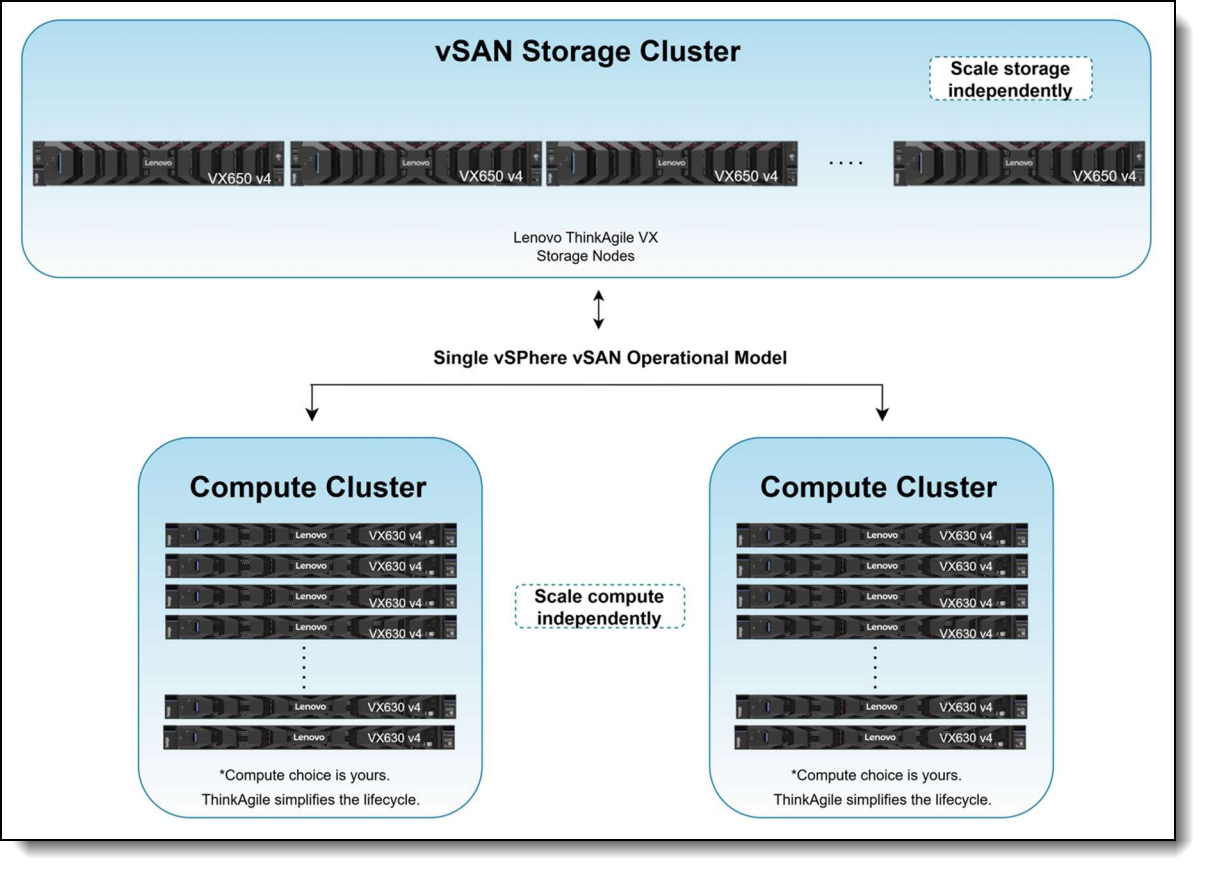
Figure 1. vSAN Storage Clusters enable independent scaling of storage and compute resources while maintaining a unified VMware operational model
Why the Platform Matters
Disaggregated storage places very different demands on infrastructure than general‑purpose HCI. Storage nodes must deliver predictable performance under sustained load, support high‑density NVMe configurations, and scale efficiently without introducing operational complexity. The success of this architecture depends as much on the platform as it does on the software.
ThinkAgile VX650 V4 is designed with these requirements in mind. Built on Lenovo’s latest server architecture, VX650 V4 supports high NVMe density, modern PCIe connectivity, and balanced CPU and memory configurations that align well with ESA‑based storage services. Delivered as part of the ThinkAgile portfolio, VX650 V4 is validated, lifecycle‑managed, and supported as an integrated system rather than a collection of components.

Figure 2. ThinkAgile VX650 V4 is designed for storage centric workloads, combining NVMe performance with Lenovo validated lifecycle management
Choosing Flexibility Without Giving Up Simplicity
One of the most common concerns about disaggregated architecture is operational overhead. Customers remember managing LUNs, zoning fabrics, and coordinating upgrades across separate infrastructure silos. vSAN Storage Clusters were designed specifically to avoid returning to that model.
From an operational perspective, the experience remains familiar. Storage behavior is defined through vSAN policies. Lifecycle operations follow the same coordinated workflows. Compute clusters consume storage without needing to understand the physical layout underneath.
What customers gain from this approach can be summarized simply:
- Independent scaling of storage capacity without forcing unnecessary compute expansion
- Consistent operations using existing vSAN and VMware Cloud Foundation workflows
- Predictable performance enabled by ESA and NVMe‑optimized designs
- Architectural choice to deploy traditional HCI, storage clusters, or both
This flexibility allows organizations to apply the right architecture where it makes sense — traditional HCI where ratios remain balanced, and storage clusters where scale, efficiency, or performance demand it.
With ThinkAgile VX650 V4 supporting vSAN Storage Clusters, Lenovo is enabling that choice without asking customers to trade simplicity for flexibility. It’s an evolution of HCI that reflects how modern infrastructure grows.
Learn More
Refer to the ThinkAgile VX Series product page to learn more about Lenovo’s co-engineered solution, purpose built to deliver a scalable and secure hybrid cloud for enterprises standardizing on VMware. The webpage includes links to the latest solution datasheet, guided demos and tours, and real world success stories from enterprise customers.
Authors
Catherine Maina is a Senior Product Manager for ThinkAgile VX at Lenovo, where she leads portfolio strategy and market direction for VMware based hyperconverged and software defined infrastructure platforms. She works across engineering, sales, marketing, and ecosystem partners to shape co engineered solutions that support modern hybrid cloud architectures, balancing scalability and operational simplicity for enterprise customers.
Markesha Parker is the WW Technical Leader for ThinkgAgile VX Hyper-Converged solutions at Lenovo. In this role, she works to deliver quality solutions integrating Lenovo and third party hardware and software. She defines the technical requirements to enable manufacturing, support, and technical sales. Markesha has worked in the IT industry for over 17 years and is currently based in Morrisville, NC.
Trademarks
Lenovo and the Lenovo logo are trademarks or registered trademarks of Lenovo in the United States, other countries, or both. A current list of Lenovo trademarks is available on the Web at https://www.lenovo.com/us/en/legal/copytrade/.
The following terms are trademarks of Lenovo in the United States, other countries, or both:
Lenovo®
ThinkAgile®
Other company, product, or service names may be trademarks or service marks of others.
Configure and Buy
Please select a locale
Full Change History
Course Detail
Employees Only Content
The content in this document with a is only visible to employees who are logged in. Logon using your Lenovo ITcode and password via Lenovo single-signon (SSO).
The author of the document has determined that this content is classified as Lenovo Internal and should not be normally be made available to people who are not employees or contractors. This includes partners, customers, and competitors. The reasons may vary and you should reach out to the authors of the document for clarification, if needed. Be cautious about sharing this content with others as it may contain sensitive information.
Any visitor to the Lenovo Press web site who is not logged on will not be able to see this employee-only content. This content is excluded from search engine indexes and will not appear in any search results.
For all users, including logged-in employees, this employee-only content does not appear in the PDF version of this document.
This functionality is cookie based. The web site will normally remember your login state between browser sessions, however, if you clear cookies at the end of a session or work in an Incognito/Private browser window, then you will need to log in each time.
If you have any questions about this feature of the Lenovo Press web, please email David Watts at dwatts@lenovo.com.


