

Top
Author
Updated
30 Apr 2026Form Number
LP2421PDF size
7 pages, 263 KBSubscribed to LP2421.
Thank you for your feedback.
Abstract
Lenovo and Nutanix have partnered to introduce Nutanix Compute only Cluster support on Lenovo ThinkSystem SR630 V4, SR650 V4, SR645 V3, and SR665 V3 servers. This solution delivers an enterprise-grade virtualization platform with greater flexibility and simplicity by allowing Nutanix's proven hypervisor to run directly on Lenovo's latest two-socket servers without requiring the full Nutanix hyperconverged infrastructure (HCI) stack. Targeting general virtualization workloads, the offering helps organizations reduce virtualization costs and complexity while preserving high performance, reliability, and global support.
In this solution brief, we outline the business challenges addressed, the primary use cases and outcomes, and the key benefits of deploying Nutanix Compute only Cluster on Lenovo servers to meet real-world enterprise needs.
Note: This solution is currently a work in progress and is not generally available at this time; specifications, supported configurations, and timelines are subject to change without notice as Lenovo and Nutanix continue joint validation and refinement.
Business Challenge
Enterprises face the challenge of controlling costs and simplifying IT operations amid rising virtualization needs. Many depend on traditional solutions with high licensing fees and complex architectures, which are costly and hard to manage. Organizations often feel locked into a single hypervisor or compelled to adopt a full HCI model, even if unsuitable for some workloads. This inflexibility causes inefficiencies, like running multiple virtualization platforms for different data center segments, leading to fragmented operations and higher costs.
As they update hardware, businesses look for future-proof, validated platforms supporting evolving needs like cloud and containers without major upgrades. The goal is to modernize virtualization—reducing costs and complexity, avoiding one-size-fits-all solutions, and enabling a flexible, consistent foundation for current and future workloads.
Solution Overview
Nutanix Compute only Cluster on Lenovo ThinkSystem SR630 V4, SR650 V4, SR645 V3, and SR665 V3 directly addresses these challenges by providing a right-sized, flexible virtualization solution on trusted hardware. Nutanix AHV is a production-proven hypervisor engineered for enterprise use. By running Compute only Cluster on Lenovo ThinkSystem servers, customers can deploy a dedicated virtualization layer on industry-leading hardware without the Nutanix distributed storage (AOS) if it's not needed.
In practical terms, this means organizations gain the core benefits of Nutanix's integrated hypervisor—simplicity, resiliency, and cloud-like management—while using externally attached storage such as Lenovo ThinkSystem DM/DG Series. The result is an agile infrastructure that unifies compute and virtualization management while leveraging existing storage investments or preferences.
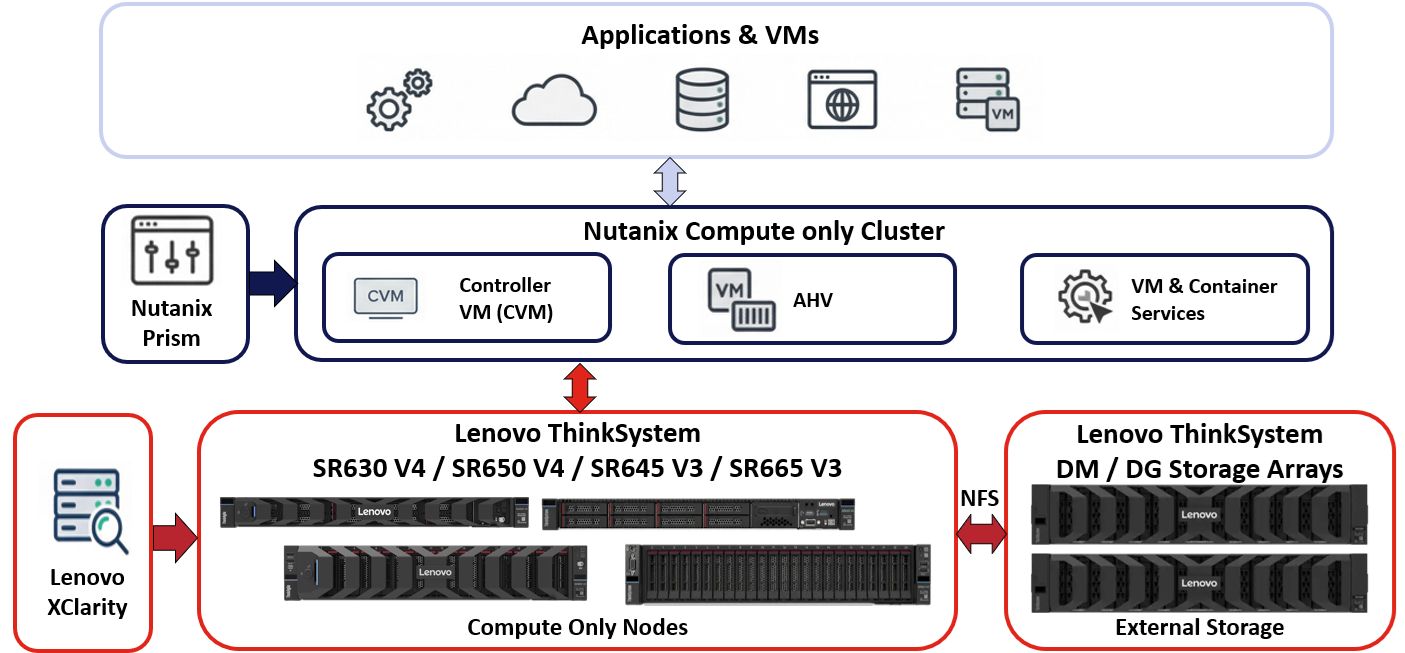
Figure 1. Nutanix Compute only Cluster on Lenovo ThinkSystem servers
The key value propositions of Nutanix Compute only Cluster on Lenovo servers include:
- Flexibility to deploy only what you need: Avoid rigid architectures—run Nutanix Compute only Cluster on standard Lenovo servers in scenarios where a full HCI appliance may not be ideal. This allows tailoring the infrastructure per site and use case (for example, standalone virtualization clusters or special-purpose deployments) without sacrificing performance or support.
- Align virtualization licensing with specific workload and business requirements: This deployment model allows organizations to license and deploy virtualization capabilities based on the needs of individual workloads, environments, or business units, rather than adopting a single, one-size-fits-all infrastructure model.
- Enterprise-grade performance and reliability: Lenovo ThinkSystem SR630 V4 (1U) and SR650 V4 (2U) deliver powerful compute with dual Intel Xeon 6 processors, fast DDR5 memory, PCIe 5.0 I/O, and advanced ThinkShield security. The SR645 V3 (1U) and SR665 V3 (2U) feature dual AMD EPYC 9005 processors with up to 160 cores per processor, exceptional memory bandwidth, and PCIe 5.0 support. All servers provide outstanding x86 reliability with 99.999% server uptime (as found in ITIC's 2023-24 reliability survey), ensuring that virtualized workloads run with mission-critical performance, security, and uptime.
- Unified management & integration: Nutanix AHV is managed through Prism, a single web console to handle VM and container lifecycle tasks with one-click operations. Meanwhile, Lenovo XClarity integrates hardware management and firmware updates, enabling full-stack life-cycle management across both software and hardware. By standardizing on Nutanix on Lenovo, IT teams can administer their entire virtualization environment through a unified set of tools and skillsets. This significantly reduces complexity and training requirements compared with juggling multiple platforms.
- Consistency from Core to Edge: Because Nutanix Compute only Cluster can run identically on Lenovo servers in the data center or at the edge, organizations achieve a consistent virtualization platform across locations. Development, test, production, and edge environments can all use Nutanix Compute only Cluster, streamlining application deployment and mobility
Target Use Cases and Outcomes
The versatility of Nutanix Compute only Cluster on Lenovo ThinkSystem servers means it can support a broad range of virtualization scenarios.
Key target use cases include:
- Enterprise Data Center Virtualization: Consolidate general-purpose VMs and enterprise applications on a resilient Nutanix Compute only Cluster cluster powered by Lenovo ThinkSystem servers.
Outcome: Simplified core virtualization with lower software licensing expenses and no compromise in performance. IT teams can scale up or out easily while maintaining high availability for mission-critical workloads.
- Development & Test Environments: Create cost-effective dev/test or lab clusters using Nutanix Compute only Cluster on Lenovo servers, where quick provisioning and teardown of VMs is needed.
Outcome: Faster time-to-market for new applications and features. Teams can spin up test environments without worrying about additional costs and ensure parity with production (since AHV in test will behave the same as in a Nutanix production environment).
- Edge and Remote Offices: Deploy lightweight virtualization at remote sites or branch offices using a small footprint of Lenovo ThinkSystem servers with Nutanix Compute only Cluster.
Outcome: Improved reliability and autonomy at the edge. Critical local services (point-of-sale, IoT processing, etc.) run on-site with high availability, reducing WAN dependency. Centralized management means remote IT can be handled with minimal local staff, and updates or troubleshooting can be done from headquarters.
- Dedicated Application Clusters: Run certain applications or databases on isolated Nutanix Compute only Cluster clusters tailored to their needs (for performance tuning, security, or compliance reasons).
Outcome: Optimized infrastructure for specific workloads. This approach improves performance for specialized applications and simplifies compliance or troubleshooting, since each cluster serves a clear purpose.
- Transition from Legacy Hypervisors: Evaluate and migrate away from existing proprietary virtualization platforms by standing up Nutanix Compute only Cluster on Lenovo servers in parallel.
Outcome: A low-risk migration path and freedom from vendor lock-in. Organizations can pilot Nutanix Nutanix Compute only Cluster in a controlled environment and gradually transition workloads to it.
By covering these scenarios, the Nutanix Compute only Cluster on Lenovo solution enables customers to start small and grow, or to complement existing environments, all while keeping management consistent. Notably, this approach offers a clear path to evolution: customers can gradually expand into the broader Nutanix Cloud Platform (adding capabilities such as software-defined storage, disaster recovery, and multi-cloud management) as their needs grow. In the meantime, they get immediate value from a streamlined solution that addresses today's needs.
Supported Platforms
This solution is planned to be available and supported on the following Lenovo server platforms:
- Lenovo ThinkSystem SR630 V4: A 1U, two-socket rack server optimized for balanced performance and density. The SR630 V4 features Intel Xeon 6 processors and is well-suited for virtualization workloads, offering powerful CPUs, large memory capacity, and enterprise features in a space-efficient form factor. It's ideal when deploying virtualization clusters in environments where rack space is at a premium or for edge installations requiring full-featured compute in a compact server.
- Lenovo ThinkSystem SR650 V4: A 2U, two-socket rack server that provides maximum scalability and configurability for a wide range of enterprise applications. The SR650 V4 features Intel Xeon 6 processors and supports a higher number of drive bays, expansion slots, and GPUs, making it an excellent choice for larger virtualization clusters or when extra storage and I/O capacity are needed.
- Lenovo ThinkSystem SR645 V3: A 1U, two-socket rack server featuring AMD EPYC 9005 processors with up to 160 cores per processor. The SR645 V3 offers exceptional performance density with support for up to 6TB DDR5 memory, PCIe 5.0 I/O, and up to 12x NVMe drives with direct connectivity. This server is ideal for high-density virtualization workloads, cloud computing, and compute-intensive applications requiring maximum performance in a compact 1U form factor.
- Lenovo ThinkSystem SR665 V3: A 2U, two-socket rack server featuring AMD EPYC 9005 processors with up to 160 cores per processor. The SR665 V3 provides ultimate scalability with support for up to 6TB DDR5 memory, up to 40x 2.5" drive bays, PCIe 5.0 expansion, and GPU support. This server excels at demanding virtualization workloads, hyperconverged infrastructure, and applications requiring maximum I/O flexibility and expansion capacity.
All servers include Lenovo XClarity Controller for unified systems management and support the latest enterprise technologies (PCIe Gen5, NVMe, advanced security) to ensure a reliable foundation for AHV-based virtualization.
Lenovo ThinkSystem SR630 V4, SR650 V4, SR645 V3, and SR665 V3 are being jointly validated by Lenovo and Nutanix for running Nutanix Compute only Cluster. They leverage Lenovo's decades of x86 server expertise—including world-class reliability and security—so customers can confidently run their virtual infrastructure on a proven platform.
Suggested Initial Configurations
To help you right-size your Nutanix Nutanix Compute only Cluster deployment on Lenovo ThinkSystem servers, the following table provides recommended starting configurations based on typical workload profiles. These configurations can be customized based on your specific requirements for CPU, memory, storage, and networking.
Starting with these configurations helps align Nutanix licenses and hardware from day one, so you pay for the capacity you need now and expand in predictable steps as demand grows.
For detailed sizing assistance based on your specific workload mix, contact your Lenovo or Nutanix representative.
Summary
Nutanix Compute only Cluster on Lenovo ThinkSystem servers offer a powerful yet simplified path to modern virtualization. By decoupling the hypervisor from an HCI-only deployment model, this solution enables organizations to deploy just the right infrastructure for each scenario—whether that's a slim virtualization layer for remote sites or an alternate hypervisor to reduce licensing costs in the data center—all on Lenovo's industry-leading hardware. The result is a more flexible, cost-effective, and consistent IT environment.
Crucially, this approach protects customers' investments and positions them for the future. Environments can start as small as needed and then seamlessly scale or evolve by integrating additional Nutanix or Lenovo capabilities over time. Through their partnership, Lenovo and Nutanix are delivering choice and long-term investment protection: customers gain an enterprise-class virtualization solution that fits their business today and provides a foundation for hybrid cloud and other advancements tomorrow. Backed by Lenovo's worldwide support organization and Nutanix's proven software expertise, organizations can adopt Nutanix Compute only Cluster on Lenovo ThinkSystem servers with confidence—achieving immediate operational and financial benefits while staying ready for what's next.
To learn how the Nutanix Compute only Cluster on Lenovo ThinkSystem Solution can fit into your environment, contact your Lenovo or Nutanix representative, or visit https://www.lenovo.com/us/en/servers-storage/alliance/nutanix.
Author
Alejandro Perez is a WW Enterprise IT Solution Manager within Lenovo’s Infrastructure Solutions Group (ISG). He leads the adoption and integration of Enterprise Infrastructure solutions, serving as the Subject Matter Expert for targeted solution architectures. He collaborates with organic and 3rd party SW ecosystem partners to drive innovation and contribute to the company's success. With over 20 years of experience in the IT industry, he has a strong background in Edge Computing, Business Development, and SAP HANA. He is passionate about bringing new technologies to the market and developing new solutions for regional markets.
Trademarks
Lenovo and the Lenovo logo are trademarks or registered trademarks of Lenovo in the United States, other countries, or both. A current list of Lenovo trademarks is available on the Web at https://www.lenovo.com/us/en/legal/copytrade/.
The following terms are trademarks of Lenovo in the United States, other countries, or both:
Lenovo®
ThinkShield®
ThinkSystem®
XClarity®
The following terms are trademarks of other companies:
AMD and AMD EPYC™ are trademarks of Advanced Micro Devices, Inc.
Intel®, the Intel logo and Xeon® are trademarks of Intel Corporation or its subsidiaries.
Other company, product, or service names may be trademarks or service marks of others.
Configure and Buy
Please select a locale
Full Change History
Course Detail
Employees Only Content
The content in this document with a is only visible to employees who are logged in. Logon using your Lenovo ITcode and password via Lenovo single-signon (SSO).
The author of the document has determined that this content is classified as Lenovo Internal and should not be normally be made available to people who are not employees or contractors. This includes partners, customers, and competitors. The reasons may vary and you should reach out to the authors of the document for clarification, if needed. Be cautious about sharing this content with others as it may contain sensitive information.
Any visitor to the Lenovo Press web site who is not logged on will not be able to see this employee-only content. This content is excluded from search engine indexes and will not appear in any search results.
For all users, including logged-in employees, this employee-only content does not appear in the PDF version of this document.
This functionality is cookie based. The web site will normally remember your login state between browser sessions, however, if you clear cookies at the end of a session or work in an Incognito/Private browser window, then you will need to log in each time.
If you have any questions about this feature of the Lenovo Press web, please email David Watts at dwatts@lenovo.com.


