

Top
Author
Published
27 Mar 2026Form Number
LP2408PDF size
11 pages, 286 KBSubscribed to LP2408.
Thank you for your feedback.
Abstract
This document summarizes Microsoft SQL Server 2025 performance on Lenovo ThinkAgile MX650 V4 systems running Azure Local. The platform combines Intel Xeon 6, DDR5 memory, and PCIe/NVMe storage to deliver stable OLTP throughput and efficient resource use.
Testing on a two node cluster with four SQL Server virtual machines confirmed solid TPC-C results and strong performance per watt. The document provides configuration guidance and highlights the management clarity enabled by Windows Admin Center, Hyper V, and Storage Spaces Direct. This document is for IT architects, database administrators, and technical decision makers evaluating platforms for modernizing SQL Server deployments.
Introduction
Deploying hyperconverged infrastructure has become the standard for organizations seeking to modernize their aging datacenter environments. Traditional large-scale storage arrays are being replaced by HCI platforms designed to support a broad range of general-purpose workloads. This shift is driven by the efficiency, resiliency, and improved price-to-performance that HCI delivers. At the same time, many customers are adopting hybrid strategies, moving selective workloads to the cloud while maintaining others on-premises to meet compliance, latency or operational requirements.
Azure Local is Microsoft’s HCI solution for customers who want to run workloads on-premises while extending to Azure for hybrid capabilities such as backup, site recovery, storage, cloud-based monitoring, and additional services.
Lenovo ThinkAgile MX Series systems, combine the Storage Spaces Direct (S2D) technology in the Azure Local host OS with Lenovo’s industry-leading server platforms to create a reliable solution. This offering provides a consistent and reliable approach to constructing modern hybrid data center infrastructures.
Lenovo Solutions for Microsoft SQL Server on ThinkAgile MX650 V4 are optimized for both Online Transaction Processing (OLTP) and Data Warehouse (DW) workloads and take advantage of the latest Intel innovations. This paper features Microsoft SQL Server 2025 running on high‑performance ThinkAgile MX650 V4 servers in a 2‑node configuration. The servers are powered by Intel Xeon 6 Scalable processors, delivering significant architectural improvements, expanded core counts, enhanced AI acceleration, and higher memory bandwidth. The MX650 V4 supports DDR5 memory operating at speeds up to 6400 MT/s and offers broad storage flexibility, including NVMe and PCIe 5.0 devices for high‑speed, low latency storage.
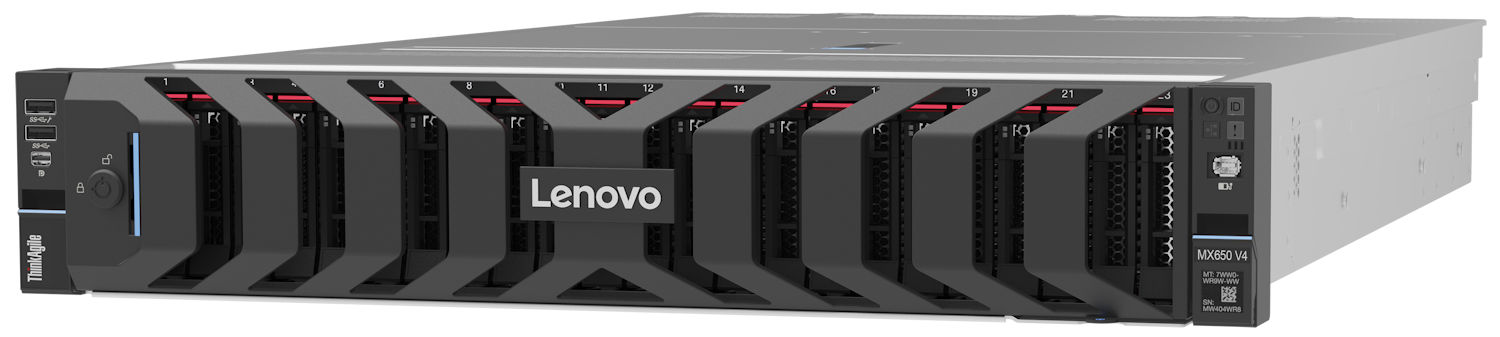
Figure 1. Lenovo ThinkAgile MX650 V4
The MX650 V4 solution is a storage dense offering, with up 28x 2.5-inch hot-swap drive bays, by using combinations of front-accessible (up to 24 bays), and rear-accessible (4 bays).It also supports 28x NVMe drives without oversubscription of PCIe lanes (1:1 connectivity), 12x 3.5-inch drive bays for lower-cost high-capacity HDD storage and M.2 drives for convenient operating system boot functions or data storage.
ThinkAgile MX Series is built with certified hardware components, and can be managed by using local tools like Windows Admin Center or the Azure Portal. Benefits like these allow businesses to deploy solutions quickly and easily.
Key benefits
The solution offers the following benefits:
- Hybrid consistency: Azure Local on ThinkAgile MX delivers a unified hybrid model. Workloads stay on‑premises while seamlessly extending to Azure for backup, recovery, monitoring, and cloud services.
- High SQL Server performance: ThinkAgile MX650 V4 provides strong performance for SQL Server 2025 through Intel Xeon 6 processors, high‑speed DDR5 memory, and NVMe/PCIe 5.0 storage, supporting low‑latency OLTP and analytic workloads.
- Simplified deployment and operations: ThinkAgile MX systems use certified hardware and integrate with Windows Admin Center and Azure Portal, making them fast to deploy and straightforward to manage.
Excellent value
The Lenovo ThinkAgile MX Series delivers strong value by combining Lenovo server engineering with Microsoft’s hyperconverged and hybrid technologies.
The Azure Local instance on ThinkAgile MX provides the following benefits:
- Storage Spaces Direct (S2D) provides a resilient and scalable software‑defined storage layer, using local NVMe and SSD resources to deliver predictable throughput and low‑latency performance for virtualized and database workloads
- Hyper‑V virtualization enables efficient consolidation, consistent workload isolation and support for mixed enterprise applications across the cluster.
- Windows Admin Center (WAC) offers a unified, browser‑based management experience for hosts, clusters, virtual machines, networking and storage, reducing operational overhead.
- Azure Local integration extends the on‑premises environment with cloud capabilities such as backup, site recovery, monitoring and lifecycle services without changing existing operational models.
- The hardware platform enhances performance and capacity through Intel Xeon 6 processors, DDR5 memory and PCIe/NVMe storage options, supporting both OLTP and analytical database scenarios.
ThinkAgile MX Series
The ThinkAgile MX650 V4 and MX630 V4 are the flexible building block for your Microsoft Azure Local solutions.
Microsoft SQL Server 2025
SQL Server 2025 (17.x) builds on SQL Server 2022 by extending Intelligent Query Processing, improving performance, enhancing availability features, and adding new language, developer, and platform capabilities. It continues Microsoft’s direction of offering a unified data platform across on‑premises, hybrid, and cloud environments.
As with SQL Server 2022, SQL Server 2025 does not install R, Python, or Java runtimes through SQL Setup. Users install any required custom runtimes separately.
Performance enhancements in SQL Server 2025 include:
- Improvements to Query Store and Intelligent Query Processing, enabling broader plan optimization and more adaptive execution behaviour
- Native JSON enhancements, including support for large JSON documents and improved indexing options.
- Optimised locking to reduce database contention and improve concurrency without code changes
- TempDB and metadata engine improvements that enhance scalability and workload
- In‑memory OLTP improvements for better engine efficiency and workload consistency
Management improvements include:
- Deeper Azure integration, including Fabric shortcuts, semantic search, and cloud‑connected management capabilities
- New linkage options for hybrid deployments using Azure SQL and Microsoft Fabric
- Always On Availability Group enhancements continue with improved failover behavior and better integration with modern cloud architectures
- Accelerated Database Recovery (ADR) remains a core engine feature for faster recovery.
Lenovo ThinkSystem MX650 V4 offerings are ideal for modernizing your legacy SQL Server applications because of their low cost and high-performance capabilities. They are industry standard x86 servers providing cost effective computing and fast high-density local storage.
Lenovo ThinkSystem MX650 V4 servers offer the necessary performance for bare metal or virtualized SQL Servers. High performance can be achieved using Hyper-V and Storage Spaces Direct technology which are built into Windows Server. Several technologies like NVMe storage and Remote Direct Memory Access (RDMA) networking are natively supported in Windows Server to enable the highest levels of performance.
Lab configuration
The configuration used for testing has the following configuration.
Best practices for SQL Server on ThinkSystem MX650 V4
To achieve the best performance from the hardware, configure the system using the following settings:
- Configure UEFI settings to set Operating mode to Maximum performance.
- Enable Hyper-Threading in the UEFI.
- Configure power profile in Windows Server to "High performance".
- SQL Server database and log drives are recommended to be formatted with 64KB NTFS cluster size.
- SQL Server database and log files should be on separate physical drives. The OS and SQL Server binary drives are recommended to be formatted with standard 4KB NTFS cluster size. TempDB is shared by many processes and users as a temporary working area and should be configured appropriately. Default configuration will be suitable for most workloads. Use the install experience for guided configuration
- If the server is dedicated to the SQL Server workload, use the default dynamic memory management model or follow Microsoft SQL documentation guidelines for manually configuring memory options if finer grain control is desired.
Performance testing and results
The testing was performed under the following conditions:
- The Azure Local environment hosted two SQL Server virtual machines per node, resulting in a total of four SQL Server 2025 VMs across the cluster.
- Each virtual machine ran SQL Server 2025 and hosted a TPC‑C database configured with 800 warehouses.
- Each VM was allocated with 16 vCPUs and 128 GB RAM to ensure consistent resource availability during testing.
- HammerDB was used as the workload generator, specifically running the TPC‑C benchmark to simulate an OLTP workload
Across the four SQL Server 2025 virtual machines, the test configuration delivered a combined throughput of 7,715,373 TPM . This result was obtained on a instance built with Intel Xeon 6505P processors, a mid-range part with 12 performance cores per socket.
The results show that the platform maintains consistent OLTP throughput even when core counts are lower. This is relevant for customers who prioritize predictable latency and stable performance rather than maximum core density.
The Xeon 6505P operates at a lower TDP compared to higher-end models in the same generation. Because of this, the system shows favorable performance-per-watt behaviour under OLTP load.
SQL Server 2025 benefits from improved intelligent query processing and metadata engine efficiencies, which help sustain throughput without requiring high-frequency turbo states for long periods. Lower power draw reduces thermal load, keeps fan speeds stable and contributes to overall efficiency.
About the benchmarks:
- HammerDB was used as the workload generation tool for performance validation. HammerDB is an open‑source benchmarking framework that implements industry‑standard workloads and can automate large‑scale transactional testing. More information about HammerDB is available at: https://www.hammerdb.com
- The TPC‑C workload used in this test is defined by the Transaction Processing Performance Council and represents a classic OLTP profile composed of order entry, payment, delivery and stock‑level transactions. Full details on the TPC‑C benchmark specification can be found at: https://www.tpc.org
Bill of Materials
The following table lists the feature codes for the lab configuration.
For More Information
To learn more about Lenovo MX solution contact your Lenovo Business Partner or visit:
https://www.lenovo.com/au/en/servers-storage/sdi/thinkagile-mx-series/
References:
Microsoft SQL 2025
What's New in SQL Server 2025 - SQL Server | Microsoft Learn
Lenovo ThinkSystem MX650 V4:
https://lenovopress.lenovo.com/lp2137-lenovo-thinkagile-mx650-v4-hyperconverged-system
Author
Laurentiu Petre is a Lenovo solutions engineer working in Bucharest, Romania. He has over 10 years of experience in the IT field being accustomed with large scale deployments of Microsoft Exchange and other Microsoft products. Before Lenovo, he managed the infrastructure of key players in telecommunications and petroleum exploitation companies. Laurentiu is currently working on SQL performance and Microsoft cloud solutions such as Edge Cloud.
Trademarks
Lenovo and the Lenovo logo are trademarks or registered trademarks of Lenovo in the United States, other countries, or both. A current list of Lenovo trademarks is available on the Web at https://www.lenovo.com/us/en/legal/copytrade/.
The following terms are trademarks of Lenovo in the United States, other countries, or both:
Lenovo®
ThinkAgile®
ThinkSystem®
XClarity®
The following terms are trademarks of other companies:
Intel®, the Intel logo and Xeon® are trademarks of Intel Corporation or its subsidiaries.
Microsoft®, Azure®, Hyper-V®, NTFS®, SQL Server®, Windows Server®, and Windows® are trademarks of Microsoft Corporation in the United States, other countries, or both.
TPC® and TPC-C® are trademarks of Transaction Processing Performance Council.
Other company, product, or service names may be trademarks or service marks of others.
Configure and Buy
Please select a locale
Full Change History
Course Detail
Employees Only Content
The content in this document with a is only visible to employees who are logged in. Logon using your Lenovo ITcode and password via Lenovo single-signon (SSO).
The author of the document has determined that this content is classified as Lenovo Internal and should not be normally be made available to people who are not employees or contractors. This includes partners, customers, and competitors. The reasons may vary and you should reach out to the authors of the document for clarification, if needed. Be cautious about sharing this content with others as it may contain sensitive information.
Any visitor to the Lenovo Press web site who is not logged on will not be able to see this employee-only content. This content is excluded from search engine indexes and will not appear in any search results.
For all users, including logged-in employees, this employee-only content does not appear in the PDF version of this document.
This functionality is cookie based. The web site will normally remember your login state between browser sessions, however, if you clear cookies at the end of a session or work in an Incognito/Private browser window, then you will need to log in each time.
If you have any questions about this feature of the Lenovo Press web, please email David Watts at dwatts@lenovo.com.


