

Top
Published
18 Mar 2026Form Number
LP2402PDF size
11 pages, 563 KBSubscribed to LP2402.
Thank you for your feedback.
Table of Contents
Abstract
This paper presents the performance and scalability of Microsoft SQL Server 2025 running on Lenovo ThinkAgile HX665 V3 systems powered by AMD EPYC 9005 processors and Nutanix software. It investigates SQL Server behavior across OLTP and DSS workloads in both scale‑up and scale‑out configurations, using a four‑node HX cluster and multiple VM sizes. The results show predictable linear scaling, efficient resource utilization, and consistent performance improvements over SQL Server 2022.
The document is intended for database architects, infrastructure engineers, solution designers, and technical decision makers assessing modern platforms for SQL Server consolidation, data‑intensive workloads, or infrastructure modernization. It also supports partners and customers evaluating Nutanix‑based HCI solutions optimized for enterprise SQL deployments.
The challenge with data growth
In our data-rich environment, businesses of all sizes are grappling with a surge of fast-moving information, making the right data collection and management tools crucial. Businesses of all sizes are being inundated by information at increasing velocity. It’s important to choose a solution that matches the requirements of the company, resulting in the most efficient outcome.
The Hyperconverged Infrastructure solution offered by Lenovo with Nutanix software simplifies IT and data center operations. By using it, the TCO is lower than the that of traditional, bare metal environments. The system is powered by 5th Gen AMD EPYC processors that offer a high number of cores.
Lenovo ThinkAgile HX665 V3 Integrated Systems with Nutanix software are optimized for Online Transaction Processing (OLTP) and Decision Support Systems (DSS). This paper presents the results of the tests we conducted with Microsoft SQL Server 2025 and Nutanix. The HX665 V3 servers are 2U systems each equipped with two AMD EPYC 9005 Series CPUs, 1.5TB of DDR5 memory and PCIe Gen5 expansion capabilities. The HX665 V3 is a storage dense offering, supporting up to 24x 2.5-inch hot-swap bays, 16 NVMe drives (with no oversubscription) and M.2 RAID for OS.
Business database solutions with faster time-to-value
Lenovo ThinkAgile HX665 V3 systems are rigorously tested and tuned to save you months of configuration, setup, testing, and tuning.

Figure 1. Lenovo ThinkAgile HX665 V3
The main features offered by the 5th Gen AMD EPYC platform are:
- Up to 192 cores (384 threads) per processor
- Up to 512MB L3 cache
- Up to 4 links of Gen 3 Infinity Fabric at up to 32 Gbps
- 12 memory channels that support up to 6TB of DDR5- 6400 memory
- Support for PCIe Gen 5 at up to 32 Gbps
- AVX-512 instruction supports for enhanced HPC and ML performance.
Microsoft SQL Server 2025
SQL Server 2025 introduces major advancements across performance, analytics, and AI integration. It builds on previous releases with expanded Intelligent Query Processing, improved platform integration, and enhancements designed for modern data‑intensive workloads.
The performance enhancements in SQL Server 2025 include:
- Optimized Locking reduces lock memory consumption and improves concurrency without requiring code changes.
- Improved Intelligent Query Processing, including Cardinality Estimation Feedback and Optional Parameter Plan Optimization, ensures more adaptive query execution
- Query Store enabled by default on readable secondaries for better performance consistency across replicas
- Native vector search performance powered by vector data types and DiskANN indexing for rapid similarity-based queries
- Real-Time Change Event Streaming provides fast, low‑overhead streaming of inserts, updates, and deletes to Azure Event Hubs or Kafka
Management improvements include the following:
- Fabric Mirroring, enabling real-time replication of SQL Server data into Microsoft Fabric without ETL processes
- REST and GraphQL support for modern application development patterns
- GitHub Copilot integration in SQL Server Management Studio for AI-assisted query writing and schema exploration
Lenovo ThinkAgile HX665 V3 systems, powered by AMD EPYC 9005 series and integrated with Nutanix software, provide an ideal platform for modernizing environments and migrating legacy SQL Server applications. These industry-standard x86 servers deliver cost-effective computing, high performance, and fast, high-density local storage.
Cluster configuration on ThinkAgile HX665 V3
In our testing we configured a four-node, dual socket ThinkAgile HX665 V3 Nutanix HX cluster with the following configuration.
VM configurations
The configuration of the cluster and the virtual machines used for testing are visualized in the following diagram:
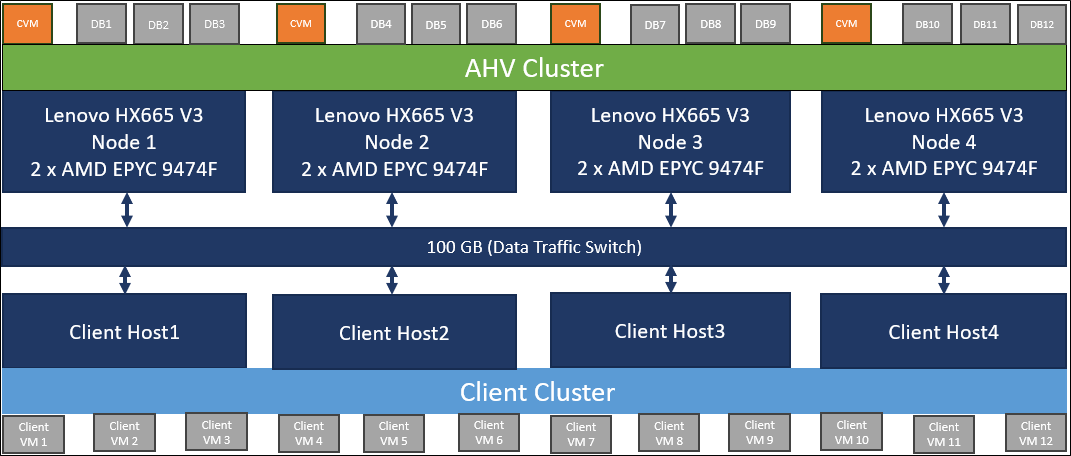
Figure 2. SQL Server 2025 topology
For the database testing, the CVMs were configured with 16vCPU and 64GB of memory.
Performance testing was done on Online Transaction Processing (OLTP) workload while the second set of testing was done on Decision Support Systems (DSS) workload.
The virtual machines that were used for testing out the Scale-Up and Scale-Out for OLTP and DSS were configured with the following resources:
OLTP performance
Scale-Up OLTP Workload testing
During the Scale-Up OLTP workload testing, the goal was to maintain approximately 80–90% CPU utilization on the tested VM. The total test duration was two hours. Performance measurements were taken after the workload reached a steady state, starting at the 30-minute mark and continuing for 90 minutes.
The following figure illustrates the scalability results achieved using Lenovo ThinkAgile HX665 V3 systems powered by AMD EPYC 9005 processors and Nutanix clusters with the Acropolis Hypervisor (AHV) storage architecture.
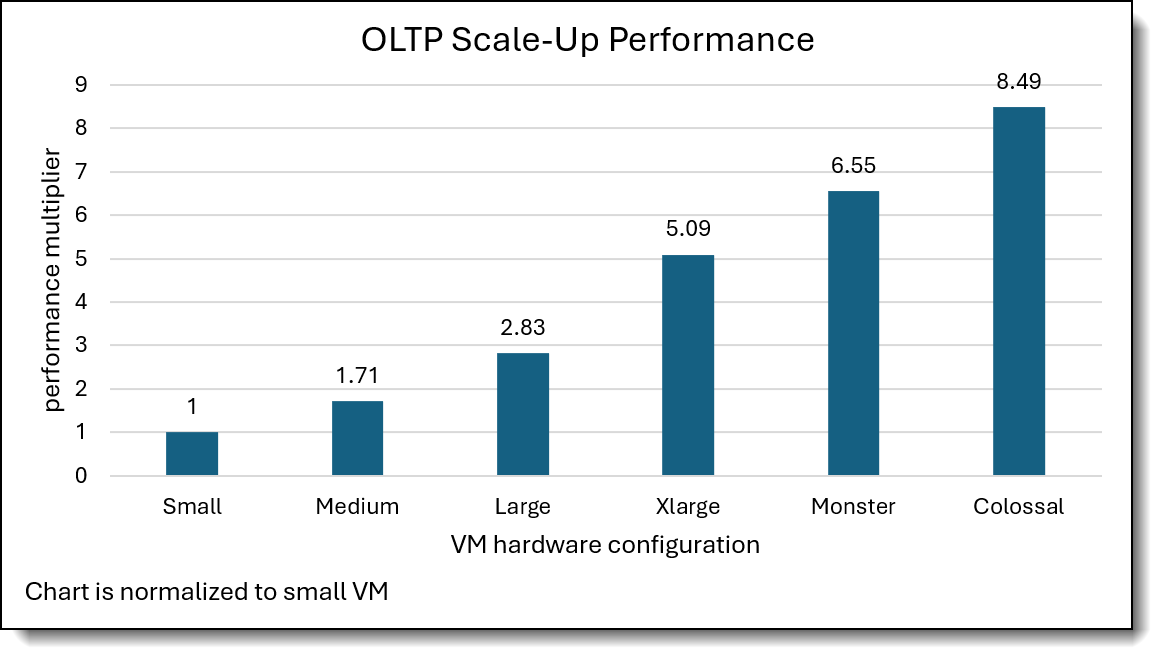
Figure 3. OLTP Scale-Up Performance (normalized data to small instance)
Scale-Out OLTP Workload testing
The Scale-Out OLTP test demonstrates the consistent performance achievable on Lenovo ThinkAgile HX665 V3 systems powered by AMD EPYC 9005 processors and Nutanix clusters. Designed for heavy SQL Server OLTP workloads, the test was executed using a Large VM configuration. The number of Large VMs was gradually increased until reaching a total of 12 instances. The MSTPCE toolkit was used with a 320K customer count, and each VM’s SQL service was configured to utilize 80% of the available memory.
After collecting IOPS and TPS data, the results showed approximately 11.44x scalability when running the OLTP workload across twelve VMs. The following figure illustrates the performance results for each VM count tested.
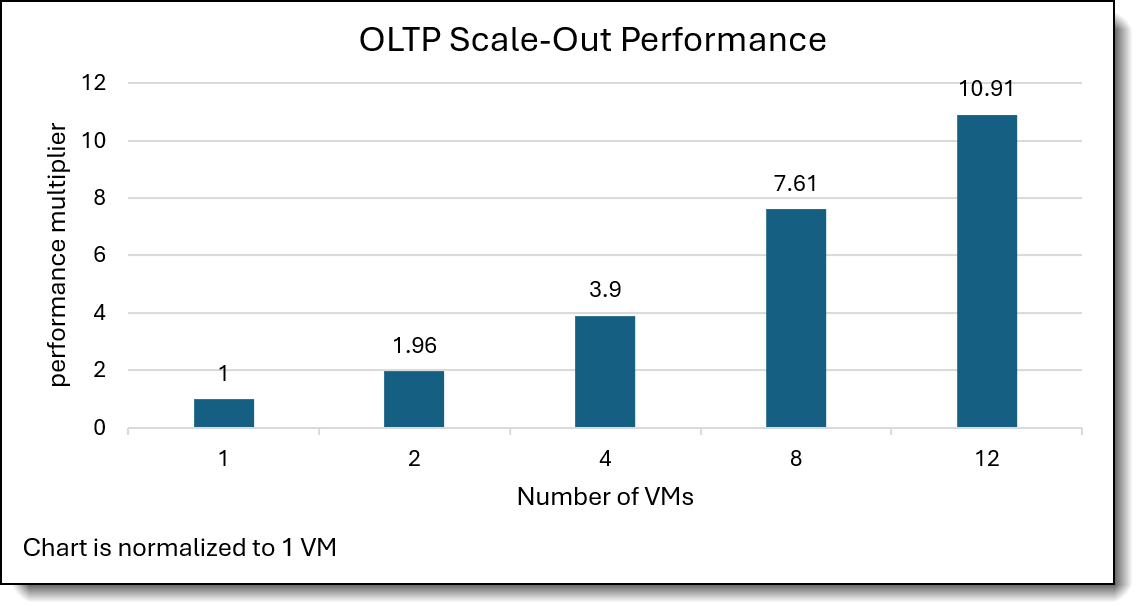
Figure 4. OLTP Scale-Out performance (normalized data to 1 VM)
DSS performance
Decision Support Systems (DSS) are designed to process large volumes of data and provide insights for business intelligence. These systems typically run complex queries that involve aggregations, joins, and data analysis across multiple tables. The TPC-H benchmark was developed to evaluate how well database systems handle these analytical workloads. It measures performance using a set of business-oriented ad hoc queries and concurrent data modifications, simulating real-world DSS environments where responsiveness and scalability are critical.
Scale-Up DSS Workload testing
The Scale-Up DSS workload test is designed to assist in sizing SQL Server VMs running on a Nutanix Acropolis Hypervisor storage architecture cluster, using varying customer counts and database sizes. The table in the VM configurations section lists the tested VM configurations along with the corresponding customer counts for each database. For all configurations, 768 GB of memory was allocated per VM. Databases were generated using the MSTPCH toolkit, and SQL Server was configured to utilize 80% of the VMs available memory.
The primary objective of the test was to achieve an average CPU utilization of 80–90%, measured through Windows Performance Monitor counters during each run. The following figure presents the scalability results obtained from these tests.
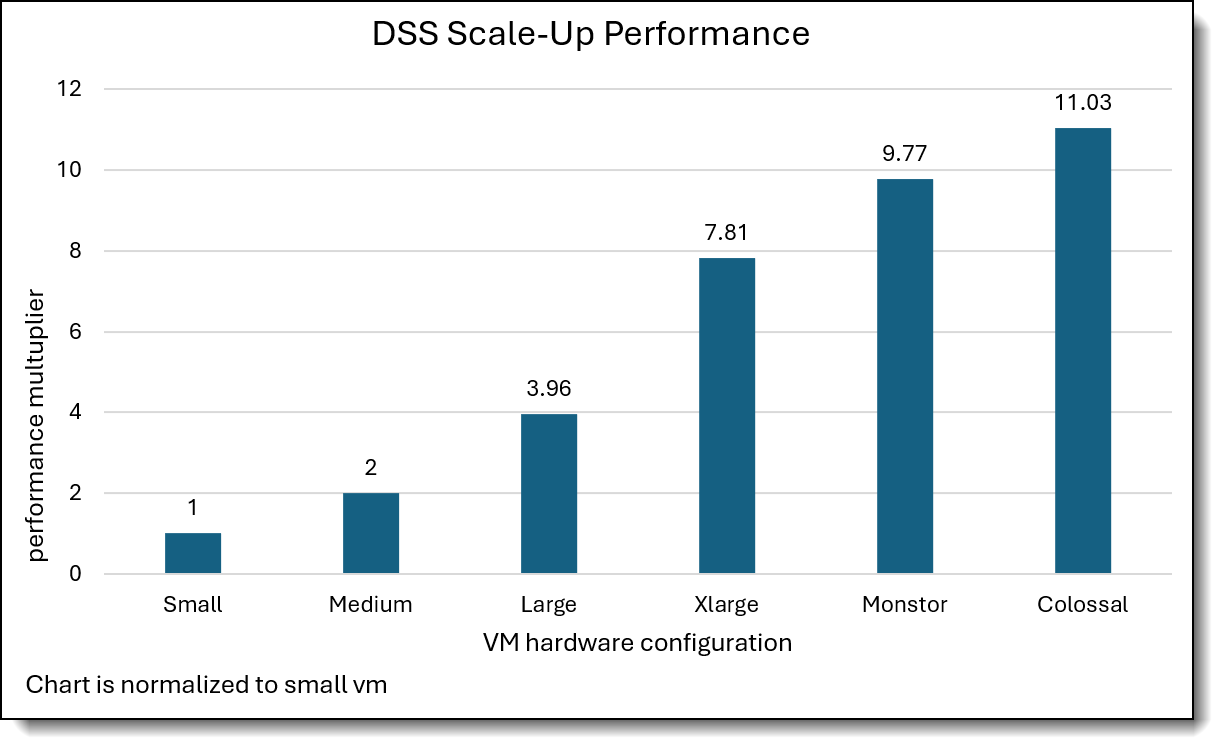
Figure 5. DSS performance on different VM configuration
Scale-Out DSS Workload testing
Scale-out testing is essential for identifying potential bottlenecks and scalability limits in database systems, ensuring they can support business growth and deliver timely insights from analytics. DSS workload testing demonstrates performance capabilities and evaluates how well a distributed computing platform processes and analyzes large data volumes across a scalable infrastructure. The Lenovo ThinkAgile HX665 V3 systems powered by AMD EPYC 9005 processors with Nutanix and running the Acropolis Hypervisor provides a seamless platform for deploying, scaling, and managing data-intensive applications such as Microsoft SQL Server 2025.
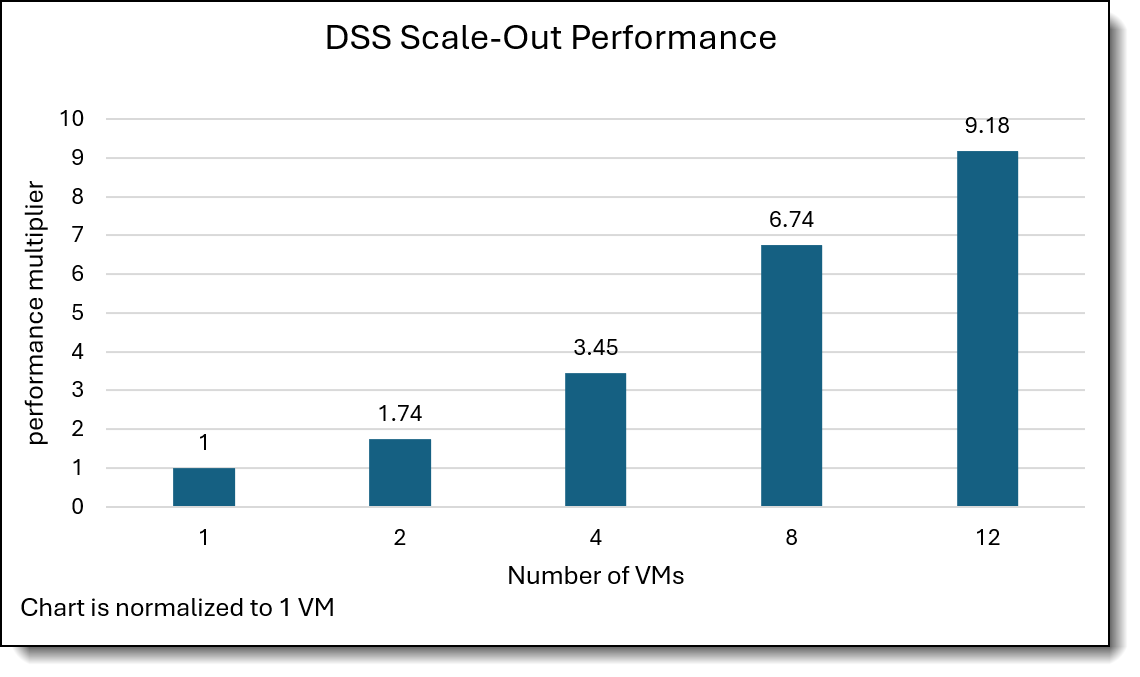
In this DSS scale-out test, we assessed the Nutanix environment’s ability to handle workloads generated by the DSS benchmark, which simulates complex decision-support queries on large datasets. Using the MSTPCH toolkit, we ran DSS workloads across up to 12 SQL Server VMs simultaneously, each configured with 80% memory utilization and databases sized for 320K customers. The objective was to measure overall performance on a 4-node AMD EPYC-powered Nutanix cluster. Starting with a single VM and scaling to 12 VMs, we monitored aggregated IOPS and normalized DSS results to evaluate scalability.
The following figure shows results for 1, 2, 4, 8, and 12 VMs, achieving ~9.18x scalability at 12 VMs, demonstrating strong performance growth as the environment scales.
Comparing the scalability of SQL Server 2025 to SQL Server 2022
Microsoft SQL Server 2025 delivers noticeable scalability gains across both OLTP and DSS workloads when compared to SQL Server 2022. Testing on Lenovo ThinkAgile HX665 V3 systems shows that SQL Server 2025 handles larger workloads more efficiently and maintains stronger performance as environments scale up or expand across multiple VMs. These improvements come from updates brought to the database engine, helping the database scale more predictably and operate steadily in both scale‑up and scale‑out configurations.
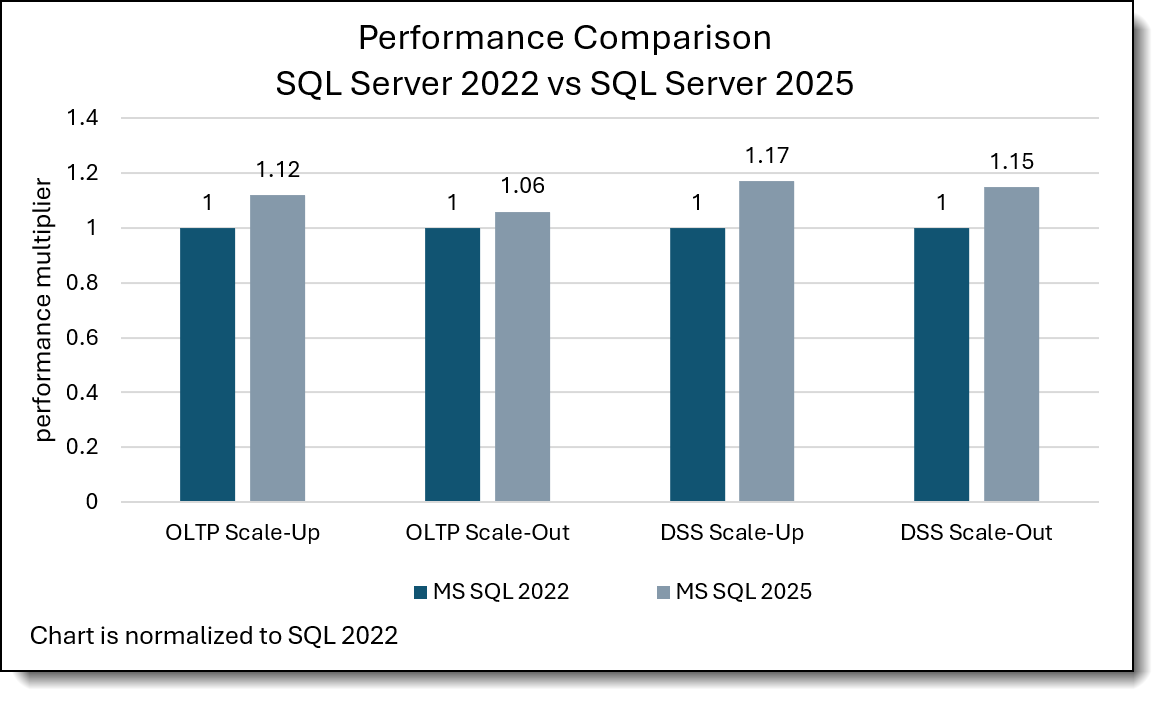
Figure 7. Comparing the scalability of SQL Server 2025 to SQL Server 2022
Conclusion
Lenovo ThinkAgile HX665 V3 systems, powered by AMD EPYC 9005 processors and integrated with Nutanix software, deliver exceptional scalability and performance for Microsoft SQL Server 2025 workloads. Through comprehensive testing of OLTP and DSS workloads in both Scale-Up and Scale-Out scenarios, the solution demonstrated strong linear scalability and consistent performance across increasing VM counts.
These results validate the platform’s ability to support demanding, data-intensive applications while simplifying infrastructure management. Combined with Nutanix’s robust data protection, disaster recovery, and automation capabilities, this solution offers a cost-effective, high-performance foundation for modernizing enterprise environments and accelerating business insights.
For more information
For more information, see the following links:
- Lenovo ThinkAgile HX Series:
https://www.lenovo.com/au/en/servers-storage/sdi/thinkagile-hx-series - AMD EPYC 9005 Series:
https://www.amd.com/en/products/processors/server/epyc/9005-series.html - Microsoft SQL Server 2025
https://learn.microsoft.com/en-us/sql/sql-server/what-s-new-in-sql-server-2025?view=sql-server-ver17 - Microsoft SQL Server 2022:
https://www.microsoft.com/en-au/sql-server/sql-server-2022
Authors
Laurentiu Petre is a Lenovo solutions engineer working in Bucharest, Romania. He has over 10 years of experience in the IT field being accustomed with large scale deployments of Microsoft Exchange and other Microsoft products. Before Lenovo, he managed the infrastructure of key players in telecommunications and petroleum exploitation companies. Laurentiu is currently working on SQL performance and Microsoft cloud solutions such as Edge Cloud.
Vinay Kulkarni is a Principal Technical Consultant in the Software and Solutions Development group at ISG, Lenovo. His current focus is on solution architectures in the areas of cloud, database analytics and AI. Vinay has more than 20 years’ experience with Lenovo, and IBM. During this time, Vinay has led diverse projects ranging from performance benchmark publications to solutions development, as well as business and technical strategy.
Muhammad Ashfaq is a Senior Solution Architect in the AMD Datacenter Ecosystems & Application Engineering Group, bringing over 15 years of extensive experience in IT infrastructure, server virtualization, and performance engineering. His expertise encompasses software-defined storage, automation, and management, as well as converged and hyper-converged solutions. Currently, Muhammad focuses on developing innovative solutions in databases, Virtual Desktop Infrastructure (VDI), big data analytics, and AI/ML for enterprise and cloud environments. His commitment to leveraging technology drives impactful advancements in the field.
Trademarks
Lenovo and the Lenovo logo are trademarks or registered trademarks of Lenovo in the United States, other countries, or both. A current list of Lenovo trademarks is available on the Web at https://www.lenovo.com/us/en/legal/copytrade/.
The following terms are trademarks of Lenovo in the United States, other countries, or both:
Lenovo®
ThinkAgile®
ThinkSystem®
The following terms are trademarks of other companies:
AMD®, AMD EPYC®, EPYC®, and Infinity Fabric® are trademarks of Advanced Micro Devices, Inc.
Microsoft®, Azure®, Copilot®, SQL Server®, Windows Server®, and Windows® are trademarks of Microsoft Corporation in the United States, other countries, or both.
TPC® is a trademark of Transaction Processing Performance Council.
Other company, product, or service names may be trademarks or service marks of others.
Configure and Buy
Please select a locale
Full Change History
Course Detail
Employees Only Content
The content in this document with a is only visible to employees who are logged in. Logon using your Lenovo ITcode and password via Lenovo single-signon (SSO).
The author of the document has determined that this content is classified as Lenovo Internal and should not be normally be made available to people who are not employees or contractors. This includes partners, customers, and competitors. The reasons may vary and you should reach out to the authors of the document for clarification, if needed. Be cautious about sharing this content with others as it may contain sensitive information.
Any visitor to the Lenovo Press web site who is not logged on will not be able to see this employee-only content. This content is excluded from search engine indexes and will not appear in any search results.
For all users, including logged-in employees, this employee-only content does not appear in the PDF version of this document.
This functionality is cookie based. The web site will normally remember your login state between browser sessions, however, if you clear cookies at the end of a session or work in an Incognito/Private browser window, then you will need to log in each time.
If you have any questions about this feature of the Lenovo Press web, please email David Watts at dwatts@lenovo.com.


