

Top
Author
Updated
18 Feb 2026Form Number
LP2376PDF size
8 pages, 279 KBSubscribed to LP2376.
Thank you for your feedback.
Abstract
As enterprise virtualization strategies evolve beyond traditional hypervisors, Red Hat® OpenShift® provides a Kubernetes-native platform that enables organizations to run both virtual machines and containers on unified infrastructure, reducing operational complexity while supporting hybrid cloud modernization.
Deployment Ready Solutions for OpenShift Virtualization (a feature of Red Hat OpenShift) on ThinkSystem® SR650 V4 provide validated, prescriptive architectures for single-server and three-node deployments. These factory-tested configurations reduce deployment risk, accelerate time-to-value, and deliver enterprise-grade resiliency for virtualization modernization.
Change History
Changes in the February 18, 2024 update:
- Added a new - Introduction section
Introduction
Enterprise IT organizations must modernize virtualization environments while maintaining stability, consistency, and supportability. As infrastructure platforms evolve, reducing deployment risk and operational variability has become critical to sustaining reliable day‑to‑day operations.
This solution brief describes Lenovo Deployment Ready Solutions for Red Hat OpenShift Virtualization, focusing on validated single‑server and three‑node deployment architectures built on Lenovo ThinkSystem infrastructure. These prescriptive designs provide a standardized foundation for deploying and operating modern virtualization platforms across edge, remote office, and data center environments.
Business Challenges
Enterprise IT teams face mounting pressure to modernize virtualization infrastructure while maintaining business continuity. The following table lists the common virtualization challenges.
Organizations need a unified, Kubernetes native virtualization platform in order to modernize their infrastructure seamlessly without disruption.
Solution Overview
Deployment Ready Solutions (DRS) for OpenShift Virtualization deliver pre‑factory-tested, enterprise‑ready architectures that modernize virtualization using a Kubernetes‑native platform. Built on Red Hat OpenShift and Lenovo ThinkSystem SR650 V4 servers, these solutions enable organizations to run traditional virtual machines and containerized workloads on a single, unified infrastructure.
Two Deployment Ready Solution configurations are available to address a range of use cases:
- Single‑Server OpenShift Virtualization - for edge, ROBO, lab, and development environments
- Three‑Node OpenShift Virtualization Cluster - for production deployments requiring high availability and workload resiliency
Together, Lenovo ThinkSystem SR650 V4 and Red Hat OpenShift Virtualization provide a scalable, future‑ready foundation that simplifies virtualization modernization and supports hybrid cloud and application transformation initiatives.
These solutions are based on the existing Lenovo Reference Architectures to reduce deployment risk and accelerate time-to-production.
To find out more information about these solutions, follow the link below:
OpenShift Virtualization Advantages
Red Hat OpenShift Virtualization extends Kubernetes to support traditional virtual machines alongside containerized workloads within a single, enterprise-grade platform:
- Unified Platform - Run VMs and containers on the same OpenShift cluster.
- KubeVirt‑Based Architecture - Manage VM lifecycle (create, start, stop, migrate) using standard Kubernetes APIs and tooling.
- Live Migration & High Availability - Built‑in resiliency for mission‑critical workload.
- Policy‑Driven Security - SELinux, RBAC, and integrated security enforcement.
- Operational Consistency - Single management experience for modern and legacy applications.
Lenovo ThinkSystem Foundation
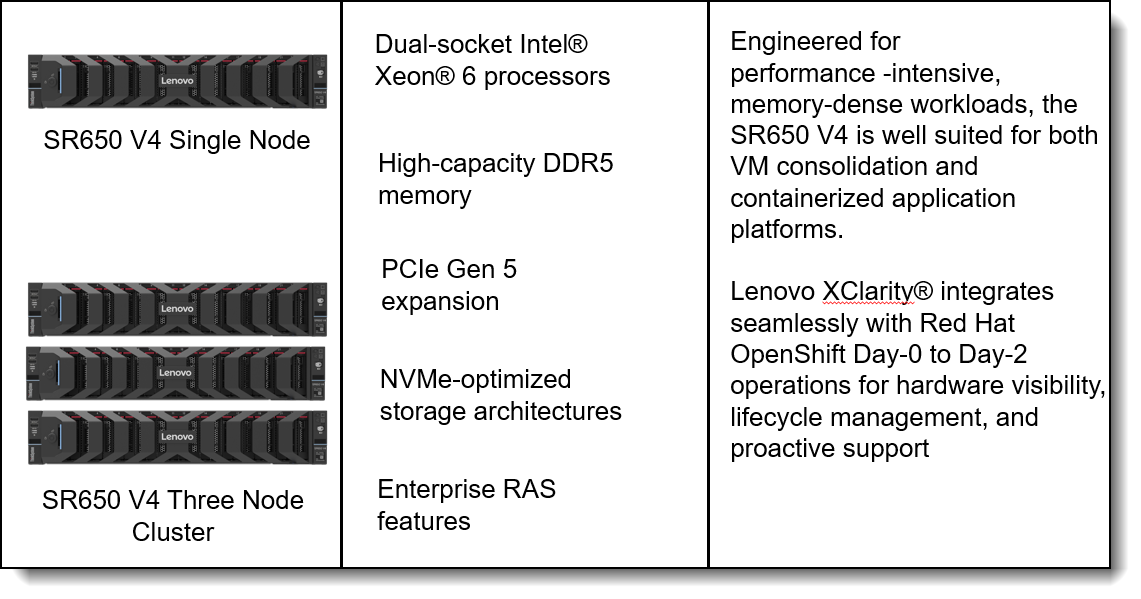
The Lenovo ThinkSystem SR650 V4 provides the enterprise hardware foundation required for OpenShift Virtualization workloads:
The following figure shows the two Deployment Ready Solutions available
Simplified Deployment and Management
Deployment Ready Solutions remove the uncertainty and complexity from platform deployment and day-to-day operations. These solutions are architected and pre-validated via the Lenovo Data Center Solution Configurator (DCSC), utilizing tested hardware profiles, reference architectures, and prescriptive configuration guidance to ensure predictable outcomes.
Standardized designs for single-server and three-node architectures from the Data Center Solution Configurator (DCSC) reduce design overhead and deployment risk. By following these validated blueprints, organizations ensure their environment is high-performing, resilient, easily supported, and fully compliant with Red Hat and Lenovo’s operational standards.
Integrating Lenovo XClarity® further drives operational efficiency by providing centralized hardware monitoring, firmware lifecycle management, and proactive support alongside the OpenShift platform. This unified model streamlines workflows and enhances full-stack visibility, allowing teams to pivot from infrastructure troubleshooting to high-priority application modernization.
Key Benefits
Key benefits of the integrated solution as follows:
- Kubernetes Native Virtualization
Consolidate virtual machines and containers on a single OpenShift platform. - Reduced Deployment Risk
Built using Reference Architecture minimizes design uncertainty, integration issues, and configuration errors, enabling faster, more predictable deployments. - Enterprise-Grade Resiliency
High availability, live migration, and policy‑driven security. - Flexible Scalability
Validated designs for single node and three node or more deployments. node and node. - Hybrid Cloud Ready
Consistent platform across on prem, edge, and public cloud environments.
Use Cases:
The solutions address a wide range of enterprise deployment scenarios:
- Virtual Machine Modernization
Transition existing VM-based workloads to a Kubernetes-native virtualization platform - Kubernetes Platform Standardization
Standardize on Red Hat OpenShift to support both virtual machines and containerized application - Hybrid Cloud and Application Modernization
Enable a consistent platform for modern application development and hybrid cloud operations using OpenShift’s unified control plane - Edge and Remote Office Deployments
Support edge, ROBO, and distributed environments with validated single-node and cluster architectures - Development, Test, and IT Transformation Initiatives
Provide developers with containerized CI/CD pipelines while maintaining legacy VM-based testing infrastructure on a unified platform
Conclusion
Deployment Ready Solutions for Red Hat OpenShift Virtualization on ThinkSystem SR650 V4 deliver a modern, Kubernetes-native approach to enterprise virtualization. These validated configurations combine factory-tested Lenovo infrastructure with Red Hat OpenShift, enabling organizations to modernize virtual workloads, reduce operational complexity, and establish a scalable foundation for hybrid cloud adoption—with significantly lower deployment risk and faster time-to-value than custom-built alternatives.
Whether you’re deploying at the edge, in remote offices, or building production clusters, these solutions provide a proven, low-risk path to infrastructure modernization with predictable outcomes and comprehensive support.
Bill of Materials (BOM)
The following table lists the bill of materials (BOM) for the Lenovo deployment Ready Node ThinkSystem SR650 V4.
Why Lenovo?
Lenovo is a US$70 billion revenue Fortune Global 500 company serving customers in 180 markets around the world. Focused on a bold vision to deliver smarter technology for all, we are developing world-changing technologies that power (through devices and infrastructure) and empower (through solutions, services and software) millions of customers every day.
For More Information
For more information, visit these resources:
- To learn more about this Lenovo solution contact your Lenovo Business Partner or visit:
https://www.lenovo.com/au/en/c/servers-storage/servers/racks/ - Red Hat OpenShift Virtualization:
https://www.redhat.com/openshift - Lenovo ThinkSystem SR650 V4
https://www.lenovo.com/au/en/p/servers-storage/servers/racks/lenovo-thinksystem-sr650-v4/len21ts0042 - ThinkSystem SR650 V4 product guide
https://lenovopress.lenovo.com/lp2127-thinksystem-sr650-v4-server
Authors
Jessie Lacome is a Platform Solutions Product Manager at Lenovo with extensive experience in enterprise virtualization and modern infrastructure platforms. He brings a strong consulting and solutions architecture background, supporting customers across on‑premises and hybrid environments. Jessie has previously held roles at Salesforce, Citrix, and Dell, where he focused on virtualization and infrastructure solutions.
Trademarks
Lenovo and the Lenovo logo are trademarks or registered trademarks of Lenovo in the United States, other countries, or both. A current list of Lenovo trademarks is available on the Web at https://www.lenovo.com/us/en/legal/copytrade/.
The following terms are trademarks of Lenovo in the United States, other countries, or both:
Lenovo®
ThinkSystem®
XClarity®
The following terms are trademarks of other companies:
Intel®, the Intel logo and Xeon® are trademarks of Intel Corporation or its subsidiaries.
Other company, product, or service names may be trademarks or service marks of others.
Configure and Buy
Please select a locale
Full Change History
Changes in the February 18, 2024 update:
- Added a new - Introduction section
First published: February 17, 2026
Course Detail
Employees Only Content
The content in this document with a is only visible to employees who are logged in. Logon using your Lenovo ITcode and password via Lenovo single-signon (SSO).
The author of the document has determined that this content is classified as Lenovo Internal and should not be normally be made available to people who are not employees or contractors. This includes partners, customers, and competitors. The reasons may vary and you should reach out to the authors of the document for clarification, if needed. Be cautious about sharing this content with others as it may contain sensitive information.
Any visitor to the Lenovo Press web site who is not logged on will not be able to see this employee-only content. This content is excluded from search engine indexes and will not appear in any search results.
For all users, including logged-in employees, this employee-only content does not appear in the PDF version of this document.
This functionality is cookie based. The web site will normally remember your login state between browser sessions, however, if you clear cookies at the end of a session or work in an Incognito/Private browser window, then you will need to log in each time.
If you have any questions about this feature of the Lenovo Press web, please email David Watts at dwatts@lenovo.com.


